
Math performance tasks go beyond “solve and show your work.” Instead of practicing a single skill in isolation, students need to apply multiple concepts to a real-world situation and make decisions along the way.
In a typical worksheet, students might solve 10 equations that all look the same. In a performance task, they need to decide which equation to write, why it works, and what their solution actually means in context.
These tasks often require students to interpret a situation, involve multiple steps or concepts within one problem, and have more than one possible strategy (and sometimes more than one reasonable answer). Math performance tasks move students from solving problems to explaining and justifying their thinking. The biggest shift is this: students are using math instead of just doing math.

Table of Contents
ToggleWhy Students Need Math Performance Tasks
Students can often follow a process when it’s clearly laid out, but struggle when they have to decide what to do on their own. Performance tasks build critical thinking skills and independence. They help students connect math to real-life situations (so it actually feels useful) and practice explaining their reasoning instead of guessing and moving on.
When To Use These Tasks
Math performance tasks don’t have to be a big, time-consuming project. You can use them:
- At the end of a unit as an alternative or supplement to a test
- After teaching a few connected skills to help students tie everything together
- As a review before assessments to see what students truly understand
- For early finishers or enrichment when you want meaningful extension work
- Once a week or once a month as a consistent routine
If you’re worried about time, start small. Even one well-designed task can give you more insight into student understanding than an entire worksheet.
Low prep math performance tasks are impactful because they don’t require hours of setup while still giving you high-level thinking, engagement, and real assessment outcomes.
Multi-Step Inequalities
This multi-step inequalities task challenges students to write and solve inequalities from word problems. Here’s the scenario:
Mia started making handmade bracelets to give to her friends and family as gifts. One of her friends suggested that she should try selling them to make some extra money to save up for college. She is excited about the idea of making some money, but is unsure about managing the finances. Mia needs your help making calculations about her total earnings and profits.

Graphing Exponential Functions
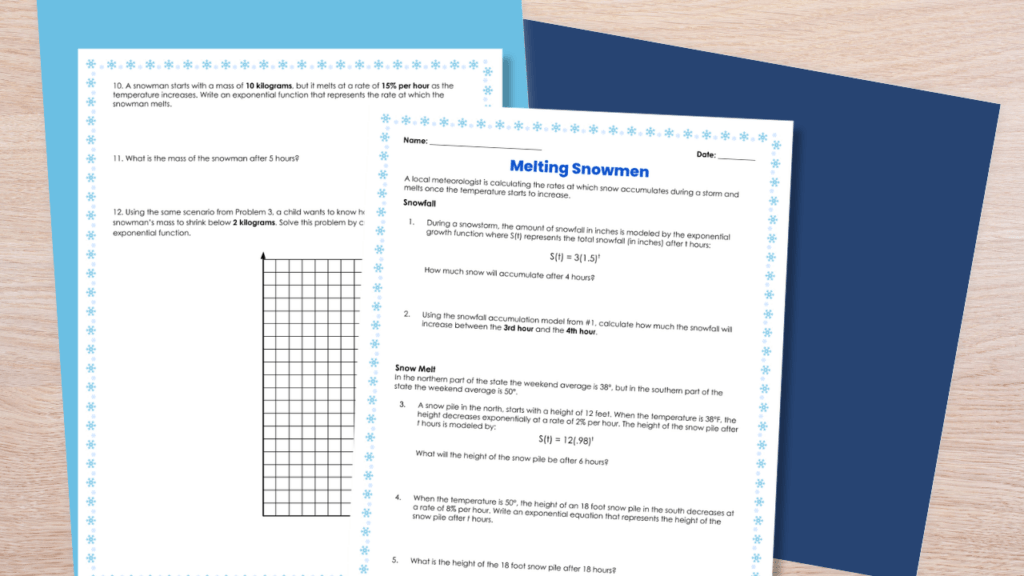
These graphing exponential functions word problems get your students thinking critically about how exponential growth and decay can be related to real life. Your students will help a local meteorologist calculate the rates at which snow accumulates during a storm and melts once the temperature starts to increase.
Graphing Polynomials
In this graphing polynomials project, students analyze real world population changes of African rhinos and elephants by comparing linear, quadratic, and cubic functions. They will research the causes and effects of the population changes to justify their answers.

Systems of Inequalities
In this real-world activity, students will create and graph linear inequalities, find the feasible region, and defend their solutions using mathematical evidence. Here’s the challenge:
The local food bank distributes canned goods and fresh produce to community members in need. However, the food bank has limited resources and needs to find a way to allocate the food they do have equitably. There are two categories of recipients: Families and Individuals. The goal is to distribute these resources fairly while maximizing the total number of people served.

Linear Functions
This realistic graphing linear functions activity will get your students thinking about growth rates and making predictions based on trends. They will help Robert plant a pollinator garden to do his part to help the environment. He will start by planting marigolds which are known for attracting bees and ladybugs and driving away unwanted flies and worms.

Standard Form of Linear Equations
This application will take your students through budgeting a day at an amusement park by making their own choices and determining how they will spend their money. They will need to write and solve linear equations in two variables using standard form.
There are two versions of this activity. The scaffolded version has more prompting questions to walk your students through each problem.

Solving Quadratic Equations
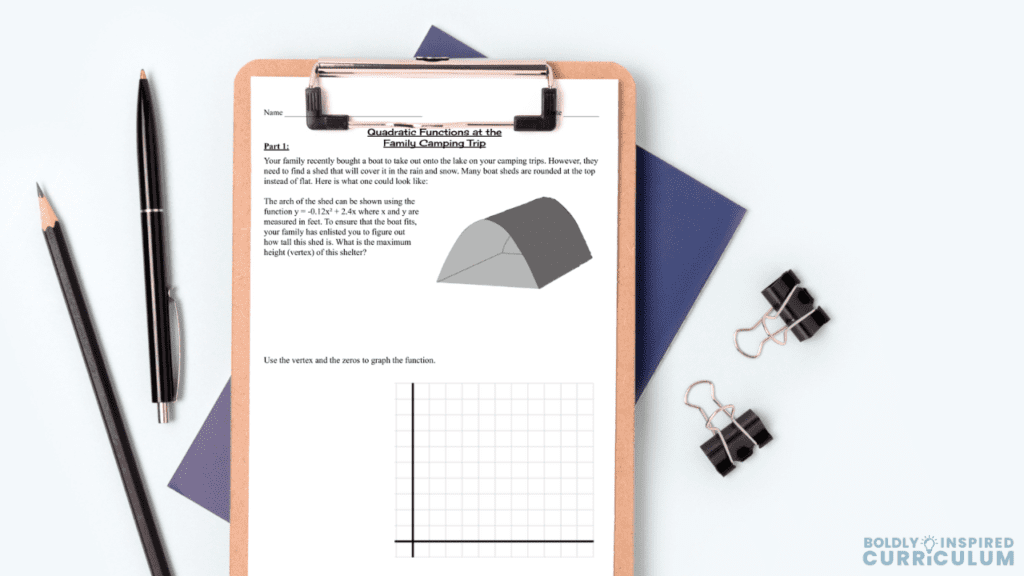
This solving quadratic equations activity is designed to engage your students while challenging them to apply their understanding of factoring and the quadratic formula. Your students will solve a variety of multi-step problems that are found around a family camping trip. This activity offers scaffolding to support students as they learn to solve word problems and navigate the problem solving process.
Vertical Motion Model
This vertical motion model application is designed to engage your students while challenging them to think outside of the box. Your students will factor out a GCF, factor trinomials when A is not 1, and find zeros of quadratics.

Solving Multi-Step Equations
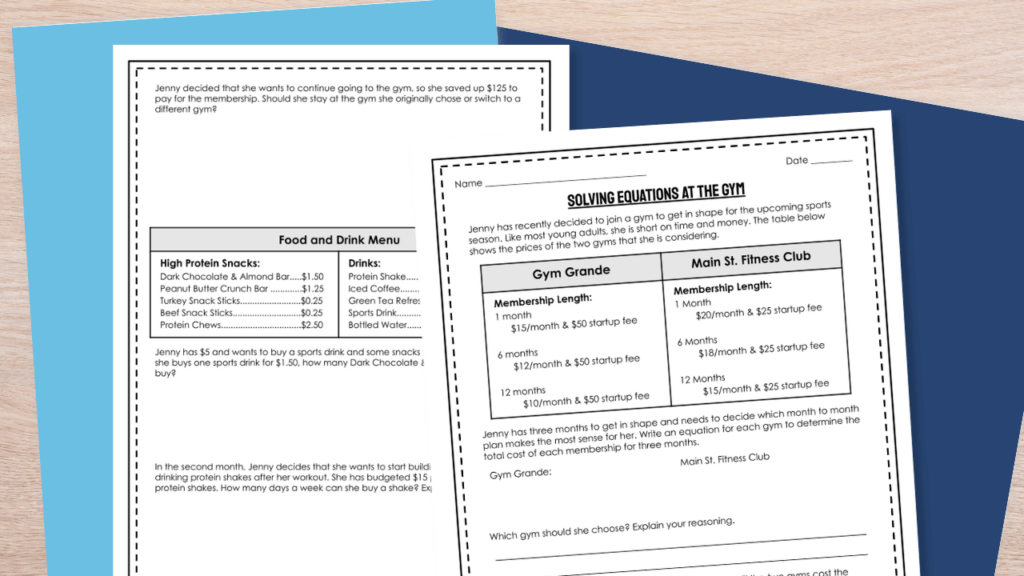
Jenny has recently decided to join a gym to get in shape for the upcoming sports season. Like most young adults, she is short on time and money. The table below shows the prices of the two gyms that she is considering. From this scenario, the students will write and solve various equations based on the cost and time constraints she has given.
Level 1 has scaffolded verbal models to prompt your students through writing equations from word problems. Once the students have written the equations, they need to make predictions and defend their solutions. Level 2 requires your students to think critically and problem solve independently.
Polynomial Operations
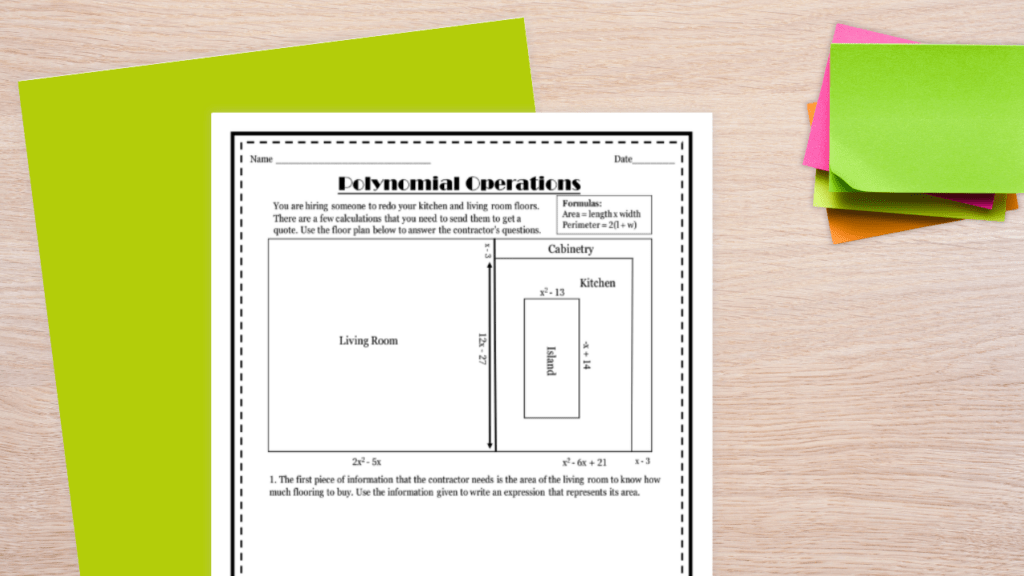
This real world math activity for adding, subtracting, and multiplying polynomials has two versions that will challenge and engage all of your students. Here’s the scenario:
You are hiring someone to redo your kitchen and living room floors. There are a few calculations you need to send to them to get a quote. Use the floor plan below to answer the contractor’s questions. From this scenario, your students will write expressions using the information given in the diagram and explain their thinking.
Factoring
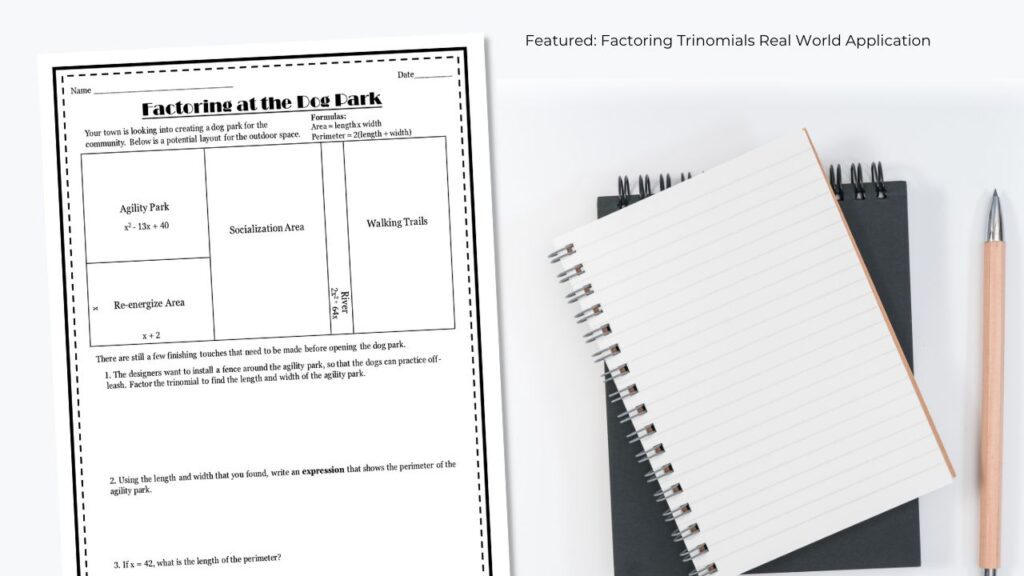
Your town is designing a new dog park and needs help adding the finishing touches. Your students will use the information given and their knowledge of multiplying polynomials and factoring quadratic expressions to fill in the missing information. Level 1 gives formulas and scaffolds the word problems, while Level 2 requires your students to think critically and problem solve.
Linear Equations in Slope Intercept Form
This writing equations in slope intercept form real world activity has two versions that prompt critical thinking at any skill level. Here’s the challenge:
You and your friend have decided to open an ice cream in town. As part of your new business venture, you will need to get a few details sorted out before opening your new shop. Your students will create and evaluate linear equations to build their business.

Parallel and Perpendicular Lines
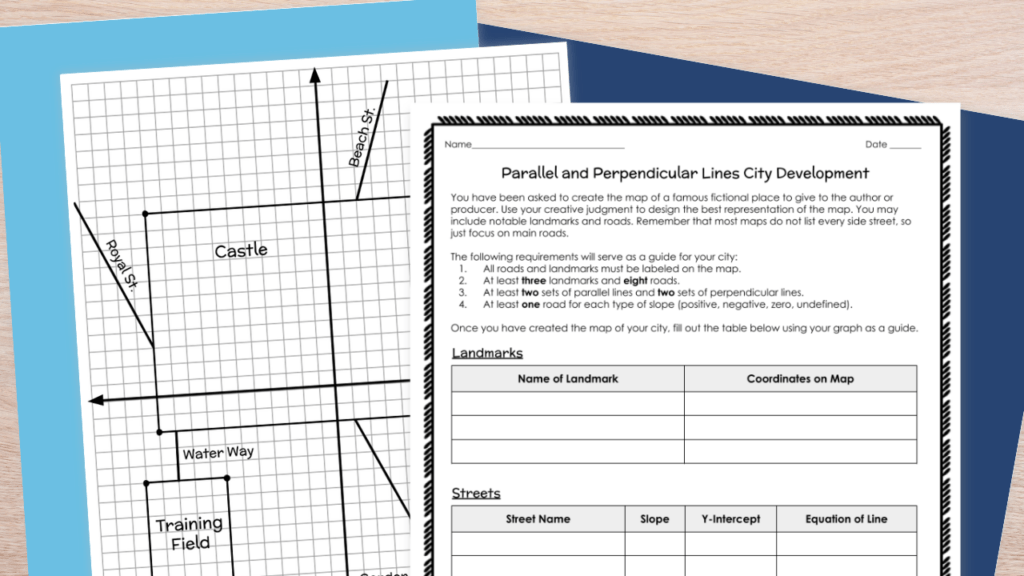
This parallel and perpendicular lines activity is the perfect alternative or supplement to a standard test. In this real world math performance task, your students will recreate a map from their favorite fictional book or movie! Open-ended math projects can be challenging for students, so clear directions and an example map are included if your students need extra guidance to get started.
Conic Sections
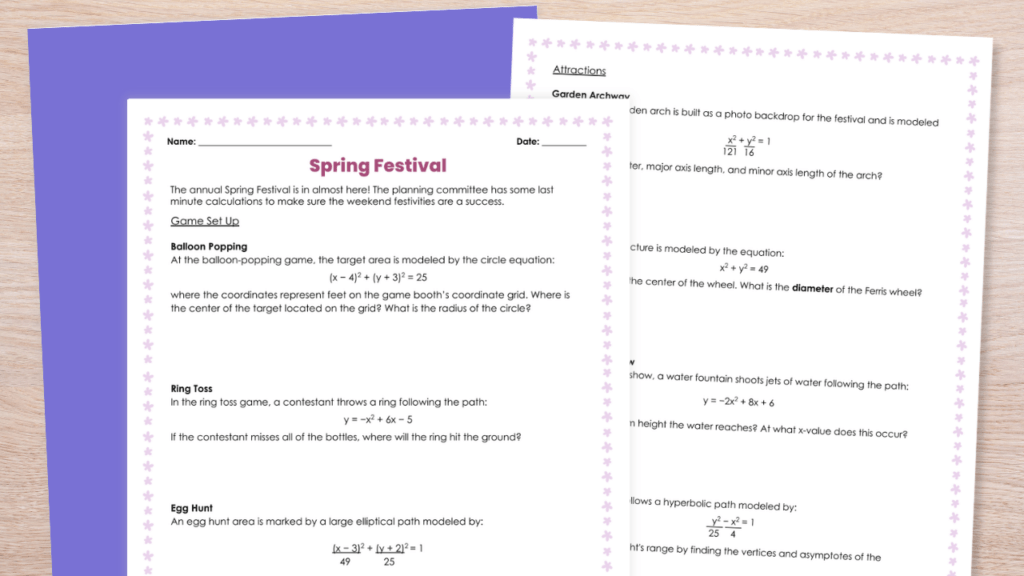
This spring-themed activity for conic sections is a perfect way to review equations of circles, parabolas, hyperbolas, and ellipses! Your students will solve each conics word problem and identify different key features. Here’s the scenario:
The annual Spring Festival is almost here! The planning committee has some last minute calculations to make sure the weekend festivities are a success.