
Your child sits down with a math assignment, stares at the first problem, and says, “I don’t get it.”
So you sit down beside them and try to help, but quickly realize the way you learned algebra 15 or 20 years ago isn’t necessarily the way your child is learning it now. Maybe the teacher uses different strategies. Maybe the vocabulary sounds unfamiliar. Or maybe you remember exactly how to solve the problem but the more you explain, the more frustrated your child becomes.
Sound familiar?
Helping with algebra homework can be surprisingly difficult and most parents aren’t doing anything wrong. In fact, many of the things parents naturally do when they’re trying to help are completely reasonable.
A few small changes in how you help can make homework less frustrating and help your child become more confident solving problems independently. Here are six common mistakes parents make when helping with algebra homework and what you can do instead.

Mistake #1: Showing Your Child the Steps Instead of Asking Questions
When your child is staring at an equation and has no idea what to do, it’s tempting to jump in with directions.
“Okay, first move the 5 to the other side.”
“Now divide by 3.”
“See? That’s your answer.”
The problem is that your child may have completed the problem without actually learning how to start the next one. When you’re helping with algebra homework, try asking questions before giving directions. Instead of telling your child what to do, ask:
“What are you trying to find?”
“What do you already know?”
“What have you tried so far?”
“What could you undo first?”
These questions encourage your child to think about the problem rather than wait for someone else to tell them the next step. The goal is to give just enough support to get them thinking again without taking over the entire problem solving process for them.
Mistake #2: Assuming There Is Only One Way to Solve a Problem
If you learned algebra using one particular method, it can be surprising to see your child solve the same problem completely differently. You might think, “Why are they doing it that way? That’s not how I learned it.”
Different doesn’t necessarily mean wrong. There are often multiple ways to approach an algebra problem. Students may use different strategies for solving equations, systems of equations, factoring, graphing, or solving quadratics.
Your child may even have learned a method you’ve never seen before. Instead of immediately correcting the strategy, ask your child to explain it.
“Can you walk me through what you did here?”
“Why did you choose that method?”
“How do you know this step works?”
If the reasoning is mathematically sound, the fact that it looks different from what you remember isn’t a problem. And if something is incorrect, asking your child to explain their thinking can help both of you figure out exactly where the confusion happened.
Mistake #3: Doing the Problem for Them
This one is incredibly easy to fall into. Your child is frustrated. You’re frustrated. It’s getting late. And you know how to solve the problem.
So you grab the pencil. Five minutes later, the worksheet is finished. Problem solved, right?
Not quite.
You may have helped your child finish their homework, but you haven’t necessarily helped them learn how to solve the problem independently. There’s an important difference between helping someone solve a problem and solving the problem for them.
If your child is stuck, you can point out relevant information, ask a question, remind them of a strategy they’ve used before, or help them identify where they got confused. Try saying:
“I’ve helped you figure out what to do. Now you try the next step.”
You don’t need to leave them completely on their own, but whenever possible, let your child write the equation, perform the calculations, and explain the reasoning.
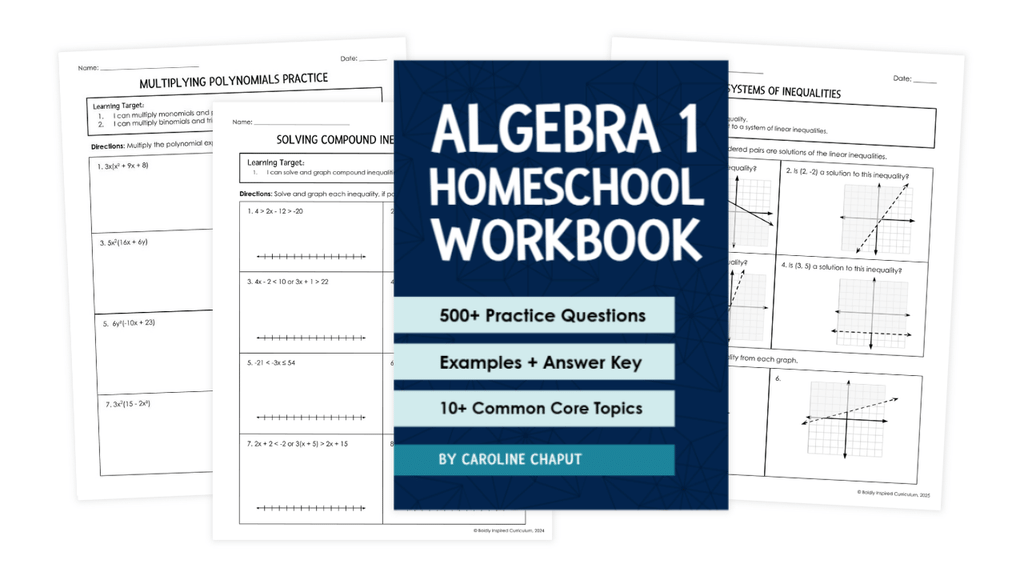
Does your child need more support in Algebra 1?
Grab this homeschool workbook with built in examples, practice problems, and answer keys.
Mistake #4: Making Algebra About Memorizing Rules
Algebra has a lot of rules and shortcuts and some of them can be useful. The problem comes when students memorize a rule without understanding the mathematics behind it. You may have heard phrases like:
“Move it to the other side and change the sign.”
“FOIL the binomials.”
“Just remember the steps.”
These shortcuts can help students get through certain problems, but they don’t always help them understand why the mathematics actually works.
For example, when you’re helping with algebra homework, rather than thinking of an equation as a series of numbers that you “move” from one side to another, students need to understand that an equation represents a relationship between two equal quantities. When solving an equation, they’re using inverse operations to maintain equality which becomes more important as the algebra concepts get more complicated.
So when your child asks, “Why do I have to do that?” try not to settle for “Because that’s the rule.” If you know the mathematical reason, explain it. And if you don’t know it, that’s okay, too. You can say:
“I’m not sure. Let’s look at your notes and see how your teacher explained it.”
Your child doesn’t need you to know every answer.
Mistake #5: When Helping with Algebra Homework Turns Into a Battle
Sometimes the biggest problem with helping with algebra homework is the fact that everyone is frustrated. Your child doesn’t understand the assignment. You’re trying to help. Your child insists that their teacher showed them a different way. You explain it again. They get more frustrated. You get more frustrated.
If this sounds familiar, take a break. You don’t have to finish the problem immediately.
Sometimes the most helpful thing a parent can do is recognize when everyone has reached their limit. If your child is consistently becoming upset during homework, try narrowing down the problem instead of pushing through the entire assignment. Ask:
“What’s the first part you understand?”
“Where exactly did you get stuck?”
“Can you show me an example from class that looks like this?”
You can also encourage your child to write down a specific question to ask their teacher the next day. And remember: you are allowed to not know how to teach the problem. Your child’s teacher is the person responsible for teaching the mathematics. Your job at home doesn’t have to be recreating that instruction.
Sometimes your most helpful role is simply helping your child stay calm enough to figure out what they don’t understand and ask for the right support.
Mistake #6: Trying to Fix Everything at Once
When a student says, “I don’t understand algebra,” it’s easy to assume they need to go back and relearn everything. But the problem is often much more specific.
A student who says they don’t understand factoring might actually be struggling with multiplication or finding factor pairs. A student who doesn’t understand a word problem might understand the algebra perfectly but have trouble identifying what the question is asking.
Before trying to reteach an entire topic, figure out where your child actually gets stuck. Ask them to work through a problem and pay attention to the exact moment the process breaks down.
Finding that specific gap makes it much easier to provide useful support. Instead of reteaching an entire algebra unit, you can focus on the one skill that’s getting in the way.
Questions to Ask When Your Child Is Stuck on Algebra
Sometimes parents know they shouldn’t give the answer but aren’t sure what they’re supposed to say instead. Here are a few questions that can help.
When your child doesn’t understand the problem:
“What are you trying to find?”
“What information do you know?”
“What is the question asking you to figure out?”
When your child doesn’t know where to start:
“Have you done a problem that looks similar to this?”
“What do you know about this type of problem?”
“What could you try first?”
When your child gets stuck halfway through:
“What step do you understand?”
“Where did you start feeling confused?”
“Can you explain what you were trying to do here?”
When your child gets an answer:
“Does your answer make sense?”
“How could you check it?”
“What does your answer mean in this problem?”
And perhaps the most important question of all: “What would you do next if I weren’t sitting here?” That question gently puts the responsibility for the problem back where it belongs: with the student.
When Should You Ask for More Help?
Parents aren’t expected to become algebra teachers. If your child consistently struggles with the same concept, can’t identify where they’re getting stuck, or seems to have significant gaps in prerequisite skills, it may be time to involve the classroom teacher or seek additional support.
You don’t need to figure out exactly what your child needs before asking for help. You can tell the teacher what you’ve noticed:
“My child understands how to solve the first few steps but gets stuck when working with negative numbers.”
That’s much more useful than simply saying, “They don’t understand algebra” because it gives the teacher a starting point. And if your child’s teacher uses a method you’re unfamiliar with, asking them to explain the approach can help you support your child without accidentally teaching a conflicting strategy at home.
Your Job Isn’t to Be Your Child’s Algebra Teacher
Helping with algebra homework doesn’t mean you need to remember every rule from high school. Your most important job is to help your child become a more independent problem solver. That means resisting the urge to immediately provide the next step and asking questions instead of giving answers.
And sometimes, it means closing the textbook, taking a break, and deciding that tomorrow is a better day to ask the teacher. Algebra can be challenging and your child needs you to help them believe that they can figure things out. And that is a skill that will help them far beyond their algebra homework.