

If you’ve ever thought, “My students barely want to solve math problems. Why would I ask them to write about math?”, you’re not alone.
Math journals often get a bad reputation in middle and high school classrooms. Teachers worry they’ll take too much instructional time, create another stack of papers to grade, or turn into one-word responses that students don’t take seriously.
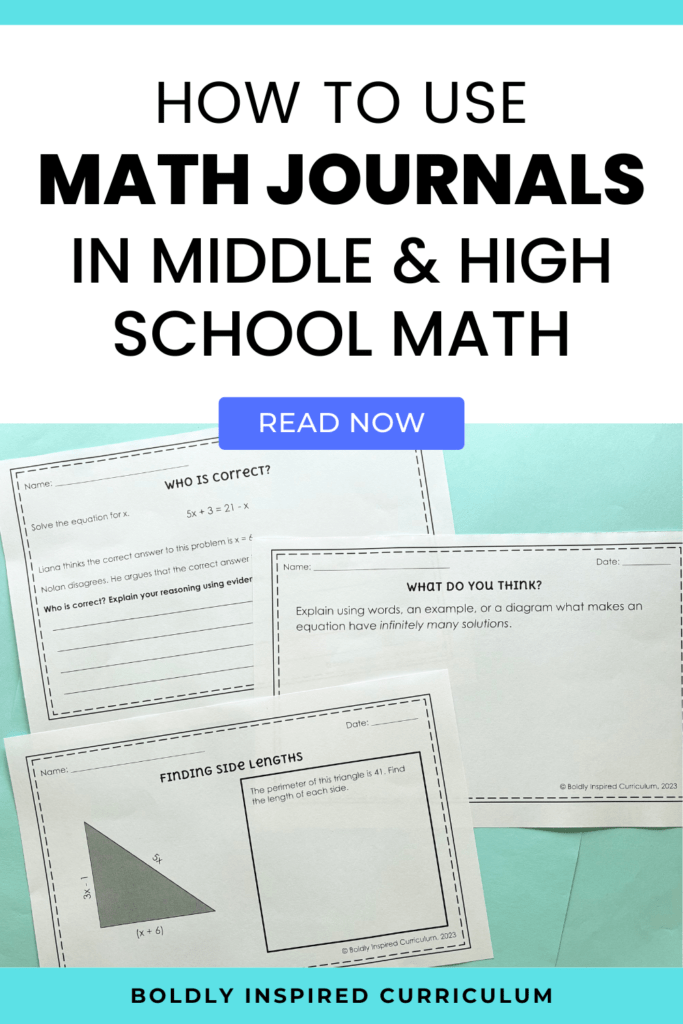
Those concerns are valid, but it’s not just about writing more. Math journals encourage students to explain their reasoning, analyze mistakes, justify their solutions, or connect math to real life. They’re developing critical thinking skills and number sense that leads to deeper understanding.
The key is to use math journals intentionally rather than as a box to check for your schools CER goals.
The Real Benefits of Math Journals
When used consistently, math journals offer benefits that traditional practice problems often don’t.
They deepen conceptual understanding
Students can sometimes complete procedures without fully understanding why they work. Writing forces students to organize their thinking, make connections, and explain concepts in their own words. If they can’t explain it, they probably don’t understand it as well as they think.
They build mathematical communication skills
The ability to communicate mathematical ideas is emphasized in today’s standards and for good reason. Whether students are discussing solutions with classmates, explaining their reasoning on assessments, or collaborating in future careers, they need practice expressing mathematical thinking clearly.
They encourage productive struggle
When students immediately ask, “Is this right?” they’re often looking for validation before they’ve fully thought through the problem. Journal prompts shift the focus away from finding answers quickly and toward making sense of the actual math process.
They give quieter students a voice
Not every student is comfortable sharing ideas during whole-class discussions. Math journals create space for every student to communicate their thinking even those who rarely raise their hand. Teachers can often gain valuable insight into student misconceptions that might otherwise remain hidden.
Examples of Math Journals
A meaningful math journal focuses on reasoning, reflection, and mathematical communication. Instead of asking students to record information, math journals ask students to process it.
Some effective journal prompts include:
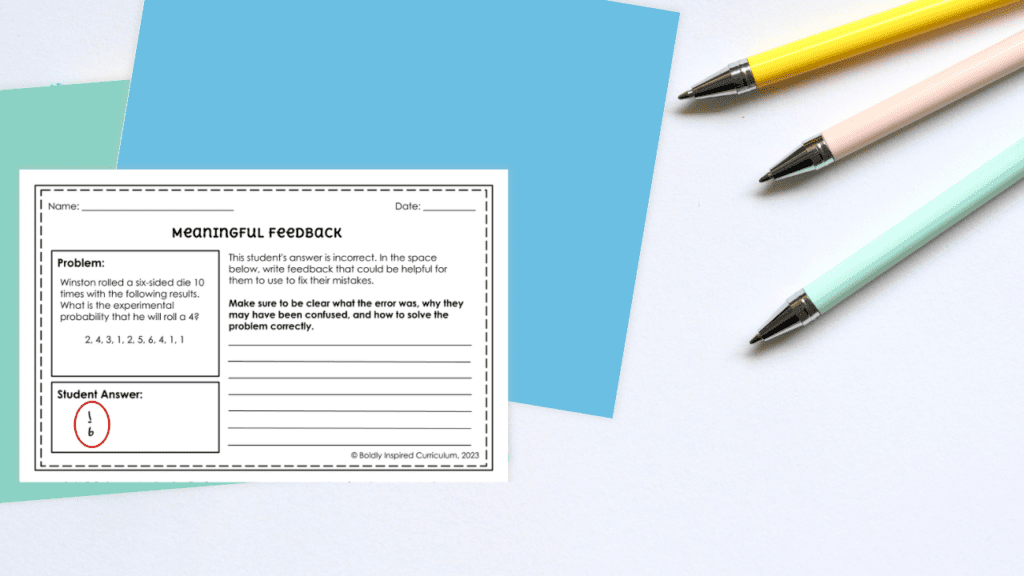
Error Analysis
Present an incorrect solution and ask students to identify the mistake, explain why it happened, and correct it. This encourages students to think critically about common misconceptions instead of simply practicing procedures.
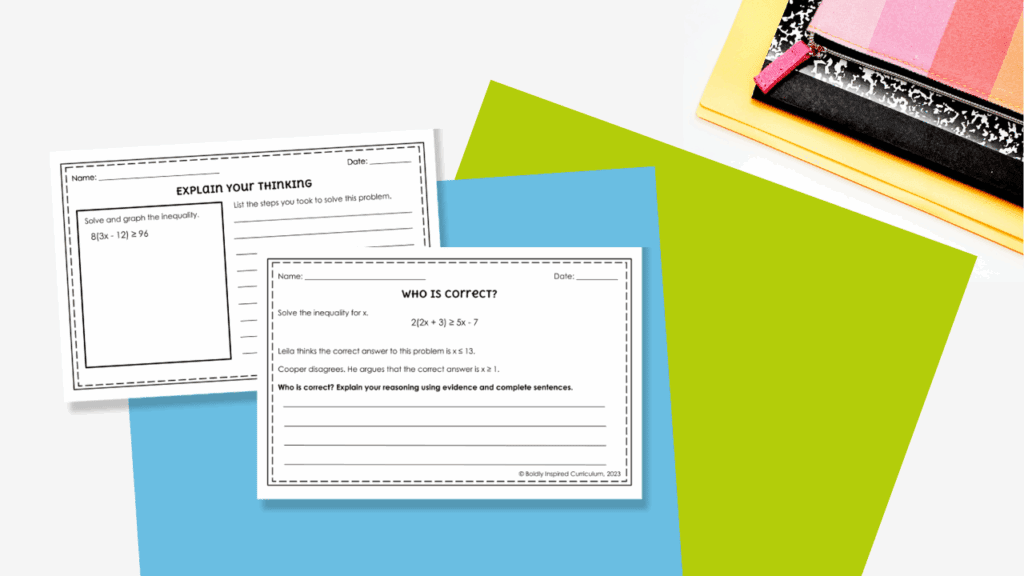
“Convince Me”
Ask students to defend a mathematical claim using evidence.
For example:
- Convince me your answer is correct.
- Convince me these expressions are equivalent.
- Convince me your strategy is more efficient than another method.
Students learn that math is about justification, not just getting the right answer.
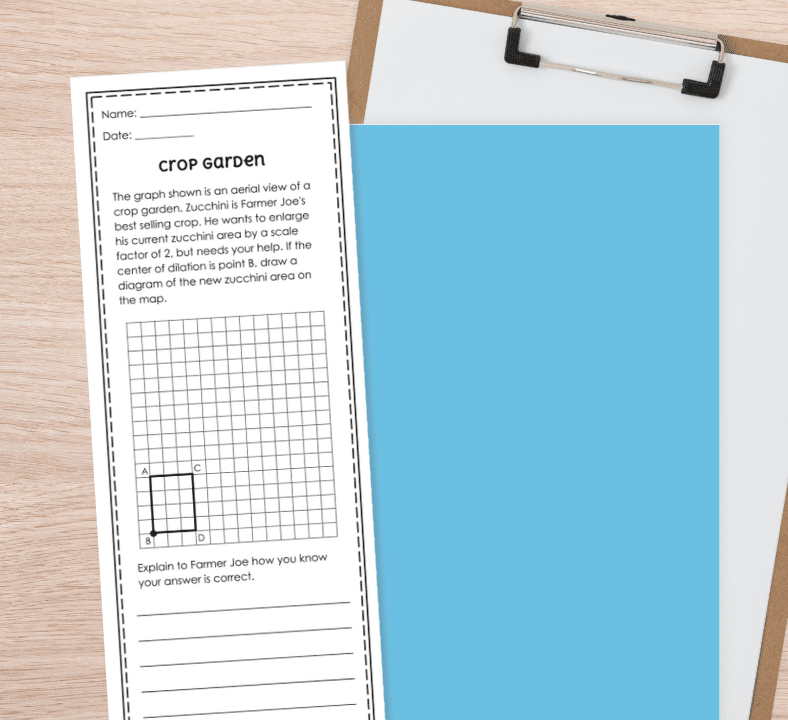
Real World Connections
Invite students to explain how a concept applies outside the classroom.
Some prompts might include:
- Where might someone use proportions in everyday life?
- Why are linear equations important in the real world?
These questions help students see math as a useful tool rather than a collection of isolated skills.
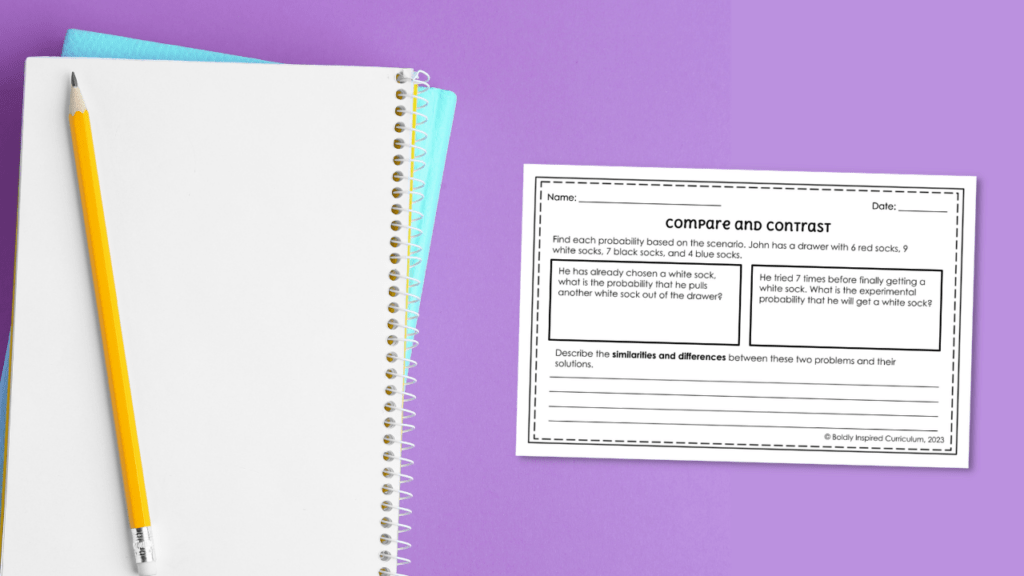
Compare and Contrast
Compare and contrast questions could look like students simply listing out similarities and differences of two problems or solutions or comparing different types of questions. As your students get more comfortable with math writing prompts, you can increase the difficulty of the problem.
How to Make Math Journals Actually Work
The difference between successful math journals and abandoned notebooks usually comes down to implementation.
Here are a few strategies that make a big difference.
Keep entries short and focused
One thoughtful question is often more effective than five rushed prompts. Choose questions that encourage reasoning rather than lengthy writing. Quality matters far more than quantity.
Simplify your grading
You don’t need to write paragraphs of feedback.
Consider grading based on:
- Completion
- Clear mathematical reasoning
- Use of evidence
- Appropriate mathematical vocabulary
A simple rubric or completion check often provides enough accountability without creating hours of grading.
Build a routine
Students are more likely to take journals seriously when they become a regular part of your classroom. Rather than using journals randomly, designate a consistent day each week or incorporate them into specific lesson types. Predictable routines reduce resistance and improve the quality of student responses.
Model what strong responses look like
Don’t assume students know how to explain mathematical thinking. Show examples and write sample responses together. Discuss what makes an explanation clear, complete, and convincing. Over time, your students begin to internalize those expectations.
When To Use Math Journals
While journals can fit almost anywhere, there are a few moments when they tend to be especially purposeful.
After problem solving tasks
Once students finish solving a rich problem, ask them to explain why their strategy worked, compare different approaches, or reflect on what they found challenging. This helps students consolidate their learning before moving on.
During review
Journal prompts can reveal misconceptions much more effectively than multiple-choice review questions. Instead of asking students to choose an answer, ask them to explain it. Their responses provide valuable information about what they’re truly ready for before an assessment.
During reteaching
When students struggle with a concept, journal writing can help uncover exactly where their thinking broke down. Sometimes a written explanation tells you more than another practice worksheet ever could. These insights make future instruction much more targeted.
Common Challenges
Time Constraints
Instructional time is limited, and it can feel difficult to justify spending class time on writing. The good news is that journal entries don’t need to be lengthy. Many powerful prompts can be completed in five to ten minutes.
Grading overwhelm
One of the biggest reasons teachers abandon math journals is the grading. Reading dozens of detailed responses every week simply isn’t sustainable.
Fortunately, journals don’t require extensive feedback every time. Many teachers successfully grade for completion, use simple four-point rubrics, or provide whole-class feedback after reviewing common trends. The goal is gathering insight into student thinking, not correcting every sentence.
Student resistance
Students may initially push back because they’re used to math being about numbers, not words. That’s normal. With consistent expectations and meaningful prompts, most students become much more comfortable explaining their reasoning over time. Like any classroom routine, math journaling becomes easier with practice.
Start Small and Be Intentional
So, do math journals really work?
Yes, but not because students are writing more. They work because students are thinking more deeply. When math journals focus on reasoning, reflection, and communication, they become a powerful tool for developing conceptual understanding and helping students become more confident mathematical thinkers.
If you’re new to math journaling, don’t feel like you need to overhaul your entire classroom. Start by incorporating one or two journal prompts each week. Keep them short, purposeful, and connected to your learning goals. You may be surprised by how much you learn about your students and how much they learn simply by giving them a chance to explain their thinking.