Figuring out if your homeschool child is ready for Algebra 1 is a tricky decision to face as a homeschool parent. This core subject is a huge leap, moving kids from simple arithmetic to abstract math concepts, and the timing can make or break their confidence and future in mathematics.
All middle school aged children learn at their own pace, so it’s important to watch for the signs that your student is ready to take on Algebra 1. Some students with strong number sense might have the maturity and foundational knowledge to succeed in Algebra 1 as early as 7th or 8th grade (12-13), potentially putting them ahead of their peers.
However, pushing your child too fast before they’re truly prepared can quickly lead to frustration, knowledge gaps, and an “I hate math” attitude. For many students, waiting until 9th grade (age 14-15) is the better move. It allows their brain to be further developed and gives them time to really master pre-algebra concepts.
The key question for homeschool parents isn’t about the calendar or a set age. The most important factor is their math readiness. Your child’s age matters much less than whether they can show they’ve mastered the necessary skills and developed the kind of critical thinking an abstract course like algebra requires.
Table of Contents
ToggleThe Essential Math Skills for Success in Algebra 1
Although it is normal for students and teachers to use calculators for basic arithmetic, having strong number sense and mental math skills makes learning Algebra 1 concepts much easier. Students who start the course with a solid understanding of pre-algebraic concepts are far more likely to succeed. The following are the five must have skill areas every student should master before they are ready for Algebra 1.
Fluency with Fractions and Decimals
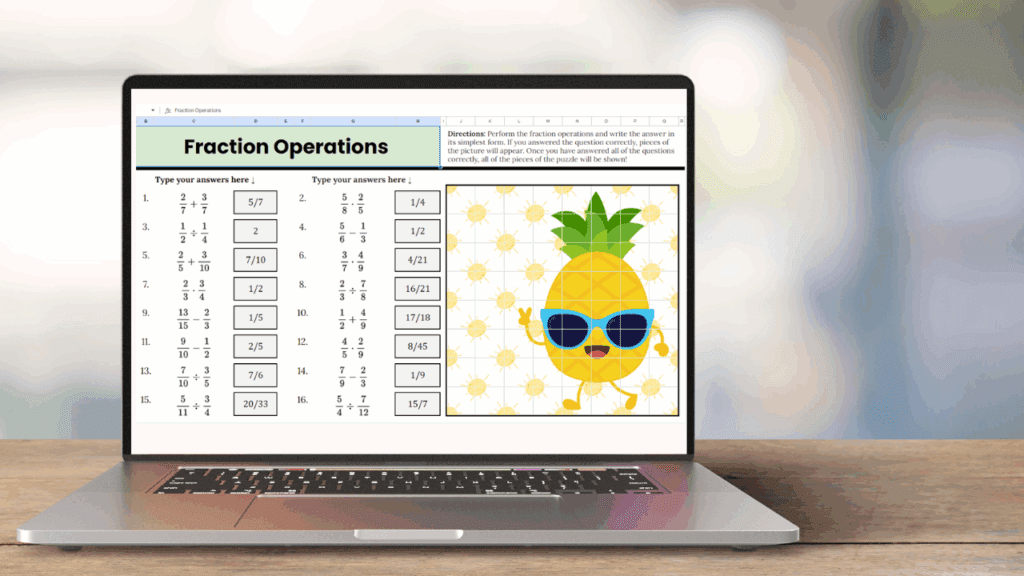
Once your child starts Algebra 1, fractions and decimals aren’t just reserved for “challenge” problems. They become a regular part of the curriculum and will often trip students up if they aren’t looking closely enough at the numbers.
This includes finding common denominators for proper and improper fractions, understanding how to use reciprocals for dividing fractions, and seamlessly moving between fractions and decimals for real world applications. Don’t let your child get held back by fraction operations!
Understanding Number Lines with Negative Numbers
Problems and questions in Algebra 1 tend to be much longer and more challenging than what your child is probably used to in pre algebra or middle school math. Simple mistakes like not changing a negative sign can severely impact a student’s answer.
Your student must be able to confidently add, subtract, multiply and divide with negative numbers (preferably without a calculator) as well as with exponents and the distributive property. It’s important for students to visualize the operation on a number line, seeing addition as moving right and subtraction as moving left, regardless of the sign of the number being added or subtracted.
Solving Simple Equations
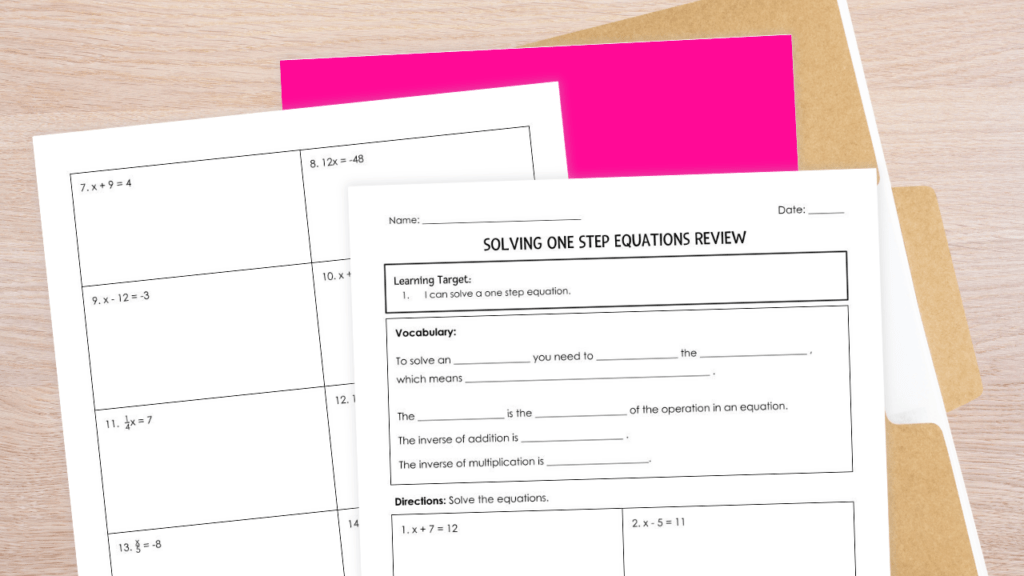
The core of Algebra is solving equations. Your homeschool child needs to have a foundational understanding of balancing an equation and isolating a variable using inverse operations.
When your child gets to Algebra 1, they will take these simple principles and apply them to more complex scenarios, such as multi-step equations, equations with variables on both sides, and systems of equations.
Mastering Order of Operations
The Order of Operations is the universal grammatical rule for mathematical expressions. Without this skill, students cannot correctly evaluate or simplify algebraic expressions, which is necessary before they can even begin to solve an equation.
This includes standard exponents, parentheses as well as brackets and absolute value symbols. Students should also be able to take an algebraic expression and correctly evaluate it when given specific values for the variables.
Ability to Work Independently for a Short Period of Time
While the first four skills are purely academic, this fifth point is an essential executive functioning skill, especially in a homeschool environment where a student is often working without the immediate, one-on-one presence of a teacher.
Algebra requires critical thinking and resourcefulness to master a new concept. The student who can work independently for 15-20 minutes on a complex problem set will thrive, while the student who needs constant intervention will likely struggle with the course’s workload and conceptual demands.
Quick Algebra Readiness Checklist
Use this checklist to determine if your child is ready for Algebra 1. If they are confident in most of these areas, then it’s time to give Algebra 1 a shot!
| Pre Algebra Skill | Yes/No |
|---|---|
| Can your child simplify complicated expressions using the distributive property | |
| Do they understand and correctly use the Order of Operations (PEMDAS)? | |
| Can they solve basic one-step equations using adding, subtracting, multiplying, and dividing? | |
| Can they find common denominators and work with fractions and mixed numbers? | |
| Can they easily switch between fractions, decimals, and percentages? | |
| Do they understand ratios and proportions and use them to solve simple word problems? | |
| Can they simplify exponents and square roots? | |
| Do they know how to plot points (x, y) on a coordinate plane? |
Signs Your Child Might Need More Pre Algebra Practice
If you spot a few of the things below, it might mean your child could use some extra focus and practice on Pre-Algebra concepts before jumping ahead. Clearing up these areas now means they’ll have a much stronger base for the more difficult concepts in Algebra 1.
Gets Lost in Multi Step Problems
Algebra problems often require following a sequence of steps (like solving equations with variables on both sides or graphing lines). If your child frequently loses their way halfway through a problem, skips steps, or can’t remember the order of operations, they need practice building those organizational and procedural skills. It’s also a sign they might be struggling to juggle too much information at once.
Struggles with Plotting Points and Graphing on a Coordinate Plane
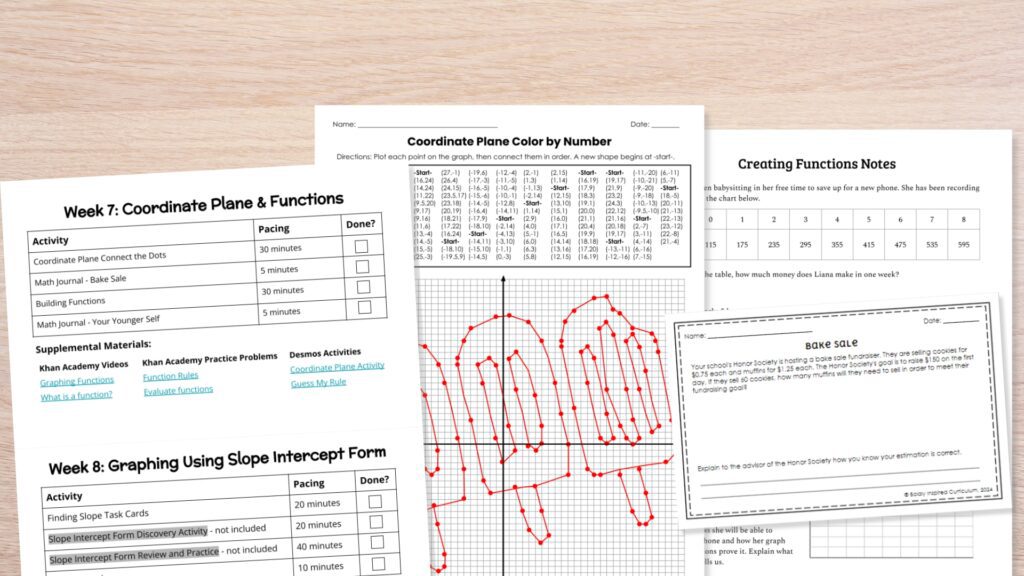
When students start Algebra 1, it is expected that they have a solid understanding of the parts of a coordinate plane. Your child should be able to identify the x- and y-axes, each of the four quadrants, and plot points without needing numbers on the gridlines.
If they haven’t mastered these skills, definitely take the time to practice them. Check out this free sample of my Getting Ready for Algebra 1 Prep packet that includes a coordinate plane activity 
Inconsistent Understanding of Variables and Algebraic Expressions
What to Do If Your Child Is Almost Ready
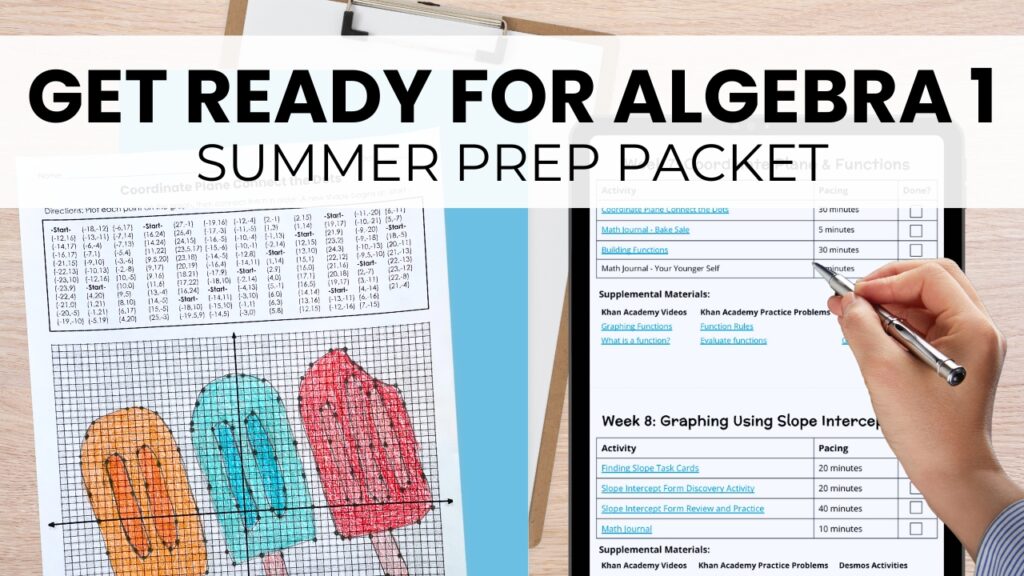
If you’re still unsure whether your child is ready for Algebra 1, I created an Algebra 1 Summer Prep Packet (don’t worry, it’s not just a packet of worksheets!).
Instead of drilling isolated skills, the packet walks students through the types of questions and critical thinking they’ll need for Algebra 1. They will work with expressions, solving simple equations, reason through word problems, and explain their thinking.
As your child works through the Algebra 1 prep activities, you’ll start to see very quickly where they feel confident and where they might need a little more support. If they can move through the problems with relative ease, that’s a strong sign they’re ready for the pace and expectations of Algebra 1.
And if they hit a few bumps along the way, that’s helpful too. It means you’ve found the gaps before the school year begins, when there’s still plenty of time to review and build confidence.
Instead of wondering whether your child is ready for Algebra 1, the prep packet gives you a simple way to find out.
For Students Who Are Ready for Algebra 1
If your child already feels comfortable with the skills in this post, the next step is giving them consistent practice with full Algebra 1 concepts.
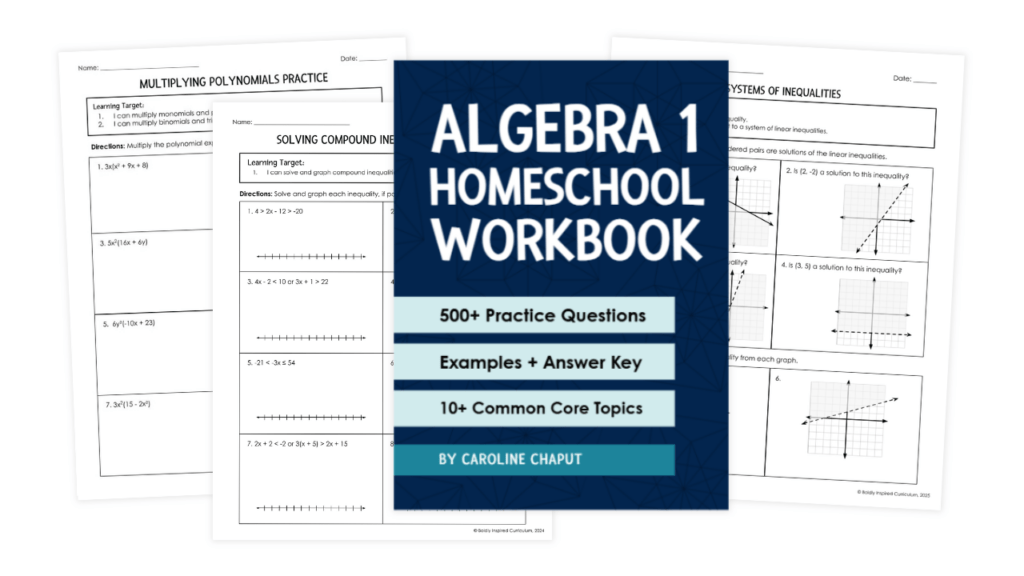
My Algebra 1 Homeschool Workbook is designed to walk students through the course step by step. Each section introduces a concept clearly, followed by practice problems that help students build confidence and problem-solving skills.
Rather than rushing through procedures, the workbook focuses on helping students understand why the math works, which is what makes Algebra 1 much easier to master. If your child is ready for Algebra 1, the workbook gives them a structured way to build those skills and move through the course independently.