

Let’s be honest, for a lot of homeschooling parents, the word “algebra” comes with a huge, heavy sigh. It often feels like a course that suddenly jumps way beyond the friendly world of elementary math and middle school pre-algebra. If you feel this looming anxiety over teaching homeschool Algebra 1, you’re not alone.
Table of Contents
ToggleWhy Algebra Feels So Intimidating
Many parents worry they simply won’t remember the rules, formulas, or solving methods themselves. High school was ages ago, and the specifics of factoring or manipulating algebraic expressions can feel impossibly distant.
Even more stressful is imagining the exact moment your child hits a wall. Parents stress that they won’t have the right words or the breakthrough insight to help. Watching your kid struggle and feeling like you lack the tools to guide them is a genuine reason to panic.
Algebra 1 is a gateway course not just for upper level math classes, but also for college applications and STEM careers. This feeling that the stakes are incredibly high only amps up the pressure to get it right.
If your biggest worry is “what if I’ve forgotten too much to actually teach it?”, I want you to know that relearning Algebra as an adult is typically easier than learning it as a teenager. With a few tips and strategies, teaching homeschool Algebra 1 is completely realistic and doable.
The main challenge in homeschooling algebra isn’t the math itself but rather finding the best way to teach it. With a solid curriculum, good resources, and a simple change in outlook, students can actually excel in algebra in a homeschool environment. The one-on-one attention and flexibility can turn a scary subject into one your child deeply understands.
This guide is designed to help you move past the math anxiety and give you a practical, step-by-step game plan. I’m sharing the signs that tell you when your child is genuinely ready for algebra, a simple breakdown of the core concepts you need to cover (from simple equations to polynomials), and an easy, flexible way to structure your lessons at home.
Is My Student Ready for Homeschool Algebra 1?
If you’re homeschooling and wondering when to start Algebra 1, don’t think about the calendar! The biggest factor is whether your child is truly ready, not just what age or grade they happen to be.
Trying to push a kid into Algebra before they’re solid on the basics is a recipe for frustration and can make them seriously dislike math. While skill readiness is key, here’s when most students usually hit Algebra 1:
8th Grade (Around 13-14): This is the classic starting line in most schools.
Advanced 7th Grade (Around 12-13): If your child is a math whiz and breezes through pre-algebra, they might be ready to jump in a little early.
Sometimes 9th Grade (Around 14-15): No big deal! If middle school math took a bit longer, starting in 9th grade is totally fine and often much better for them!
Before tackling more complex math concepts, your student needs to feel confident in a few core areas. These are the signs that their math skills are strong enough to start homeschool Algebra 1:
- They should be completely comfortable working with fractions and decimals quickly and accurately. This includes adding, subtracting, multiplying, and dividing all of them (even mixed and improper ones).
- A solid grip on negative numbers is a must. They need to be able to do all the basic operations with positive and negative integers confidently, without having to always grab a calculator.
- They should already be able to solve simple equations like x + 5 = 12 or 3y = 21 either in their head or super easily. This shows they get the idea of a letter standing for an unknown number.
- Your student needs to be able to work on their own for focused chunks of time (20-30 minutes) to practice and think through new ideas without needing you right there the whole time.
Quick Algebra Readiness Check for Parents
Use this simple list for a fast gauge. If your child can confidently say “Yes” to most of these, they are probably good to go for Algebra 1.
| Pre Algebra Skill | Yes/No |
|---|---|
| Can your child simplify complicated expressions using the distributive property | |
| Do they understand and correctly use the Order of Operations (PEMDAS)? | |
| Can they solve basic one-step equations using adding, subtracting, multiplying, and dividing? | |
| Can they find common denominators and work with fractions and mixed numbers? | |
| Can they easily switch between fractions, decimals, and percentages? | |
| Do they understand ratios and proportions and use them to solve simple word problems? | |
| Can they simplify exponents and square roots? | |
| Do they know how to plot points (x, y) on a coordinate plane? |
If your child feels good about most of the skills above and shows they can work independently, they’re probably ready to start homeschool Algebra 1. Starting with a solid foundation makes the whole math journey much smoother, more successful, and a lot less stressful!
What Students Actually Learn in Algebra 1
Your child’s first year of algebra is all about getting really good at a handful of related ideas. Here’s a detailed breakdown of the must-know topics, plus the actual skills they’ll practice:
Solving Equations and Inequalities
This is the core of Algebra 1. Your child likely already knows how to solve one step equations and inequalities, but in Algebra 1 they move on to multi-step equations and inequalities that include combining like terms and the distributive property. This will also be the first time they are introduced to equations with variables on both sides of the equal sign.
Linear Equations
In pre algebra, students learn how to find slope and graph a line using slope-intercept form. Algebra 1 extends these concepts by teaching linear equations in point-slope form and standard form. Your child will learn how to write and graph equations using all three forms and understand the four different types of slope.
Systems of Equations
We move past finding just one unknown to dealing with situations that have two or more variables. Your child will learn the three main ways to find the common solution between two equations: graphing, substitution, and elimination.
Exponents and Polynomials
You will want to review exponent properties with your student, then move on to simplifying polynomial expressions. Your child will learn how to classify polynomials by degree and number of terms as well as performing operations (add, subtract, multiply) on polynomials.
Factoring and Solving Quadratic Equations
Algebra 1 is the first time your child will solve equations when the variable is a degree of two instead of one. The bulk of this unit is factoring quadratics then solving using the zero product property. Some curriculums include the quadratic formula to solve equations, but it is not necessary.
Once you’ve got a solid handle on these key topics and how they link up sequentially, the next logical and vital step is figuring out how to build a great, engaging, and customized algebra curriculum and lesson plan in your homeschool environment.
A Simple Structure for Teaching Algebra at Home
This straightforward daily routine will help your child build a strong foundation in algebra. The key to successful homeschooling is providing real, practical value through consistency and making the learning process transparent. Implementing a structured routine helps both the parent-teacher and the student know what to expect, making the daily lesson efficient and meaningful.
Step 1: Review a Previous Problem (5 minutes)
Math skills are built over time and not learned in isolation. If your child struggles to explain yesterday’s work, you will know right away that you need to re-teach or clarify a concept before moving on to more complex material.
Here’s an example of what this could look like in real time:
Select one challenging or foundational problem from the previous day’s lesson. Don’t just ask for the answer. Ask your student to explain their thinking out loud. “Walk me through the steps you took to solve for x and why you chose to use the distributive property first.” Talking through a problem reinforces their understanding and highlights any confusion.
Step 2: Learn a New Example (10 minutes)
This is the direct instruction phase where a new concept or technique is introduced. Students learn math best when they see worked examples. Instead of lecturing, walk through a problem step-by-step together. Use this time to make your child an active participant in the learning process.
These are some great examples of prompting questions to get started:
- “What should we do first to isolate the variable?”
- “Why does adding 5 to both sides of the equation work?”
- “What rule tells us we can combine these terms?”
Step 3: Independent Practice (15–20 minutes)
This is the “doing” phase. The student takes the reins and applies the concept learned in Step 2.
Tips for Effective Practice:
- Always start with easier, foundational problems that closely mirror the original example from Step 2. This builds immediate confidence.
- Gradually introduce problems that require slightly more steps or combine elements from previous lessons. This provides opportunities for your student to problem solve using what they already know.
Always encourage your child to show their work. This will show you their full thought process and allow you to see where they are making mistakes so they can be easily corrected.
Step 4: Check Answers and Discuss Mistakes
It is important to emphasize to your child that their mistakes are not failures. These mistakes represent some of the best opportunities for learning.
Using your student’s work from Step 3, you can have a supportive and non-judgmental discussion. Focus on the reasonableness of a solution first and how to check their work.
Once they have identified that they made a mistake, see if they can figure out what went wrong and fix it on their own. This is a great time to discuss some common misconceptions and get your student to think critically.
A Simple Algebra Workbook Option for Homeschool Students
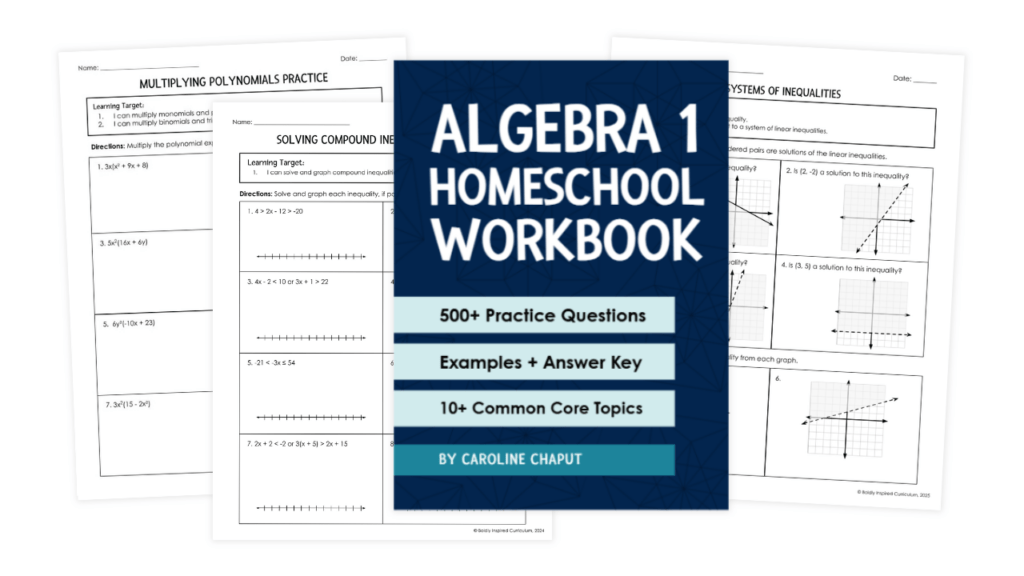
If you’ve started looking for homeschool algebra resources, you’ve probably noticed something quickly: many math programs feel overwhelming. Some move too quickly, others assume students already understand the steps, and many don’t provide enough guided examples for students to really learn the process.
When students struggle in algebra, it’s often not because they “aren’t good at math.” More often, they simply need to see clear examples and get enough practice solving problems step-by-step.
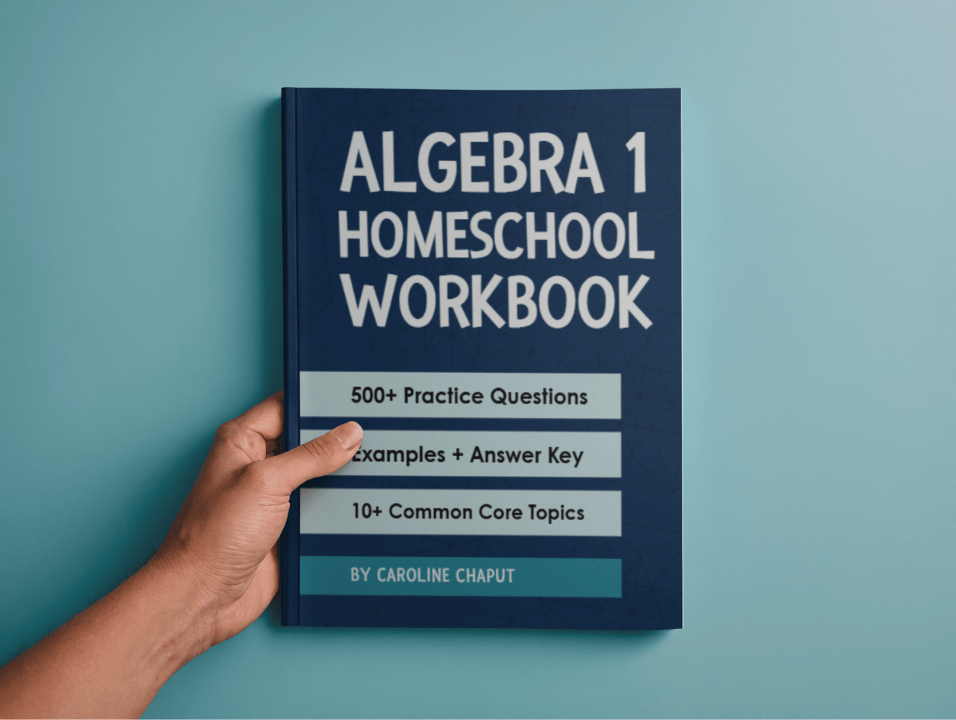
That’s exactly the idea behind the Homeschool Algebra 1 Workbook I created.
I’ve spent years teaching middle school and high school math, and one pattern shows up again and again: students build confidence when they can see how a problem is solved before trying one themselves. When instruction jumps straight to practice problems without modeling the thinking process, students are much more likely to get stuck.
This workbook was designed to make algebra more approachable for both students and parents by focusing on three things that matter most when learning math.
Clear, Step-by-Step Example Problems
Each new concept includes worked examples that show exactly how the problem is solved. Instead of just presenting the final answer, the steps are written out so students can follow the reasoning and understand why each step works.
These examples give students a model they can refer back to while working on their own problems, which is especially helpful for homeschool students who may be learning more independently.
Structured Practice That Builds Skills Gradually
After reviewing the example problems, students work through practice questions that gradually increase in difficulty. This allows them to build confidence with the concept before moving on to more challenging problems.
Rather than jumping around between topics, the workbook focuses on helping students master one skill at a time so they can develop a strong foundation in algebra.
Answer Keys for Easy Checking
Answer keys are included so students can check their work and parents can quickly see where mistakes may have happened. This also allows students to work more independently, which can be a big help for homeschool families balancing multiple subjects and grade levels.
For many homeschool families, a workbook like this works well as either a primary algebra resource or a supplement for extra practice and review alongside another curriculum.
It was created specifically to help students learn algebra step-by-step while giving homeschool parents a clear and manageable way to guide their child through homeschool Algebra 1.
Final Thoughts About Teaching Homeschool Algebra 1
Teaching homeschool Algebra 1 is manageable by focusing on three core principles. You do not need to master the math. Your role is to facilitate learning, keep your child on track, and help them find resources when they are stuck. The right curriculum provides the necessary instruction.
Second, implement a short, focused daily routine that includes a lesson and practice to build concepts sequentially and reduce anxiety.
Finally, choose a curriculum that is clear, incremental, and supportive. A well-designed resource minimizes your stress and allows your child to thrive in a self-paced environment.