
Do your students know how to calculate, but fall apart when faced with real word problems? If so, you’re not alone. Many teachers express that their students can perform procedures but freeze when they see a scenario they must model and reason through. That’s where math problem solving activities come into play. These math performance tasks are designed for thinking, interpreting, and making sense of mathematics in context in addition to computation.
In this post, I’m breaking down what true problem solving looks like, giving you 15 activities you can use tomorrow, and walking through a specific multi-step equation task you can implement in your middle school math class.
Table of Contents
ToggleWhat Real Problem Solving Looks Like
“Problem solving” and “solving a problem” aren’t always one in the same. Problem solving in math class is about making sense of the situation, applying strategies, and explaining reasoning, not just getting the right answer.
These skills transfer beyond math class and are exactly the skills employers say students need most. When we build these habits daily (not just on “word problem day”), students become more confident, independent thinkers.
12 Activities That Build Problem Solving Skills
Good math problem solving activities require students to think, not just mimic procedures. These activities don’t have to be extensive. In fact, the more you can weave these simple changes into your everyday routines, the more impactful they will be for your students.
Daily Routines
Notice & Wonder Warm Ups
Show a graph, image, or scenario and ask: What do you notice? What do you wonder? This lowers the entry barrier and gets every student thinking before numbers even appear.
Estimation First
Before solving, students make a reasonable estimate and justify it. This builds number sense and prevents blind calculator use.
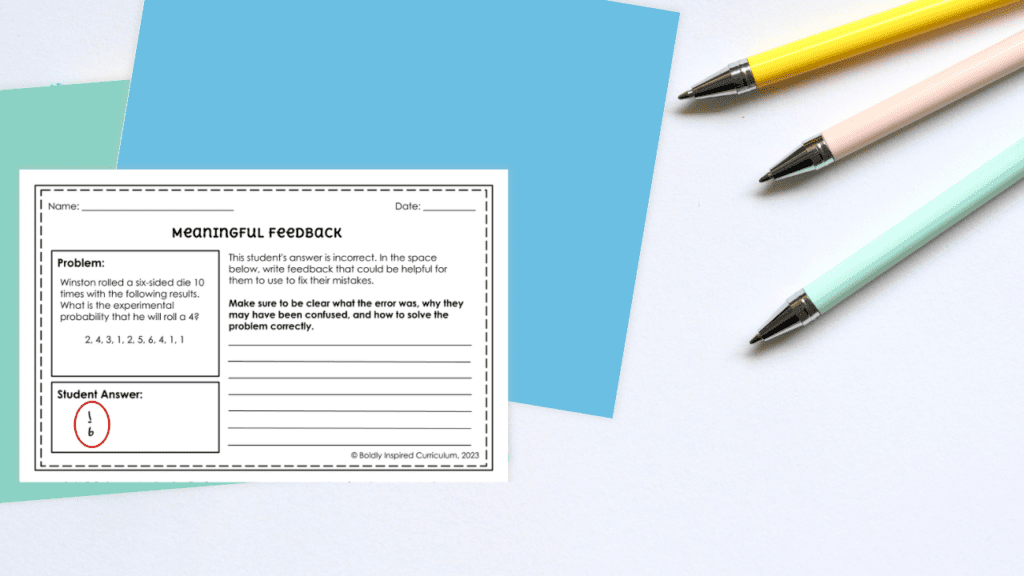
Error Analysis
Provide an incorrect solution and ask students to diagnose the mistake. Analyzing errors often creates deeper learning than getting it right the first time.
Collaborative Tasks
Think-Pair-Share Strategy Talks
Students solve individually, then explain their approach to a partner. Talking through reasoning strengthens conceptual understanding.
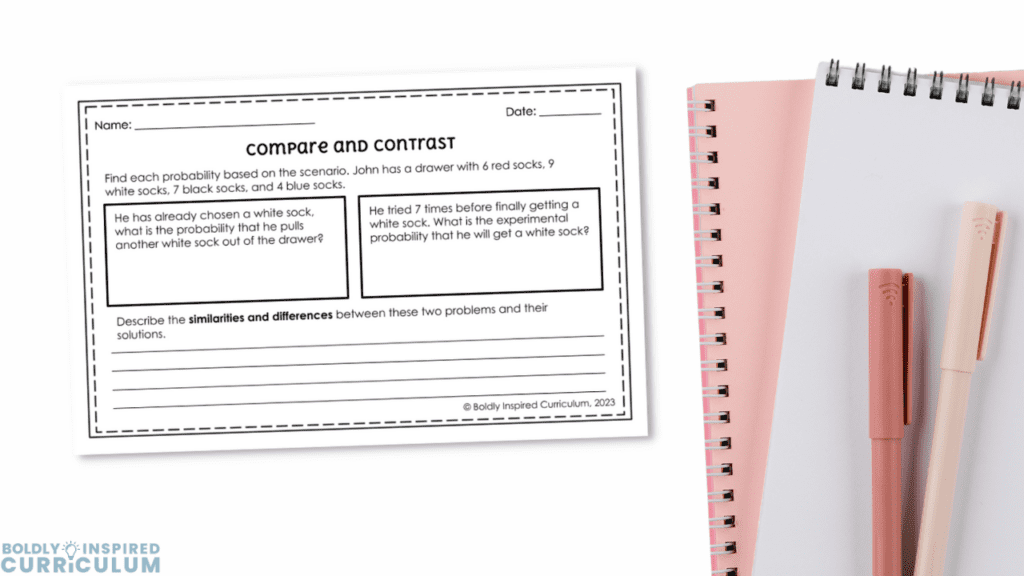
Task Card Stations
Set up stations with short, real-world problems. Rotations keep energy high while exposing students to multiple contexts and strategies.
Gallery Walks
Post problems around the room. Students solve, compare strategies, and leave feedback on sticky notes. Movement + collaboration = high engagement.
Multiple Strategy Challenges
Require two different solution methods (table and equation, graph and equation, etc.). This builds flexibility instead of dependency on one method.
Real World Applications
Real World Mini Projects
Give students a scenario like budgeting, planning an event, or comparing pricing plans. They must model and justify decisions with math.
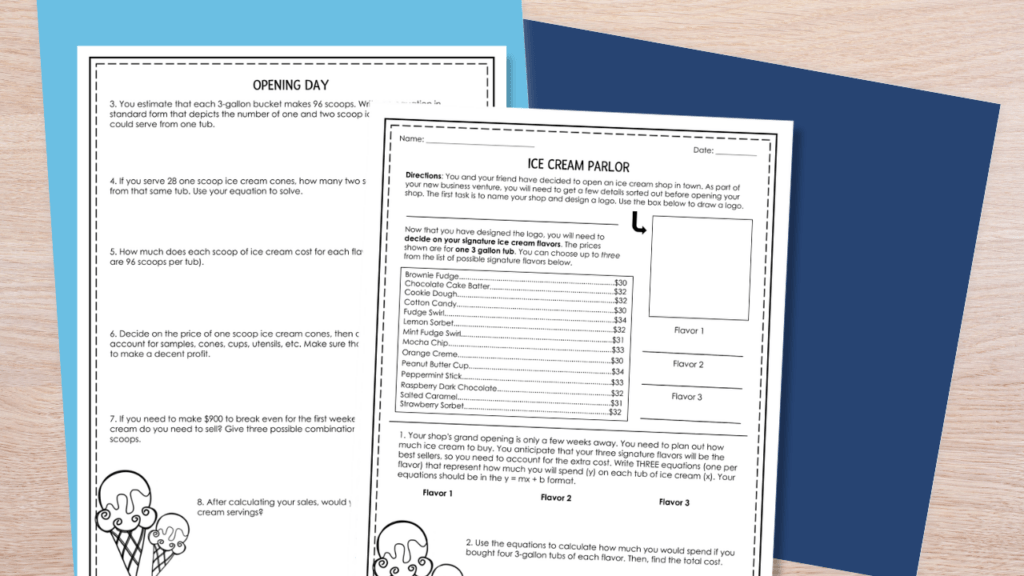
Create Your Own Word Problem
Students design a problem that matches a given equation or graph. Creating problems deepens understanding of structure.
Writing Based Strategies
Math Journals
Students explain how they solved a problem in writing. This strengthens communication skills and reveals misconceptions you might not catch otherwise.
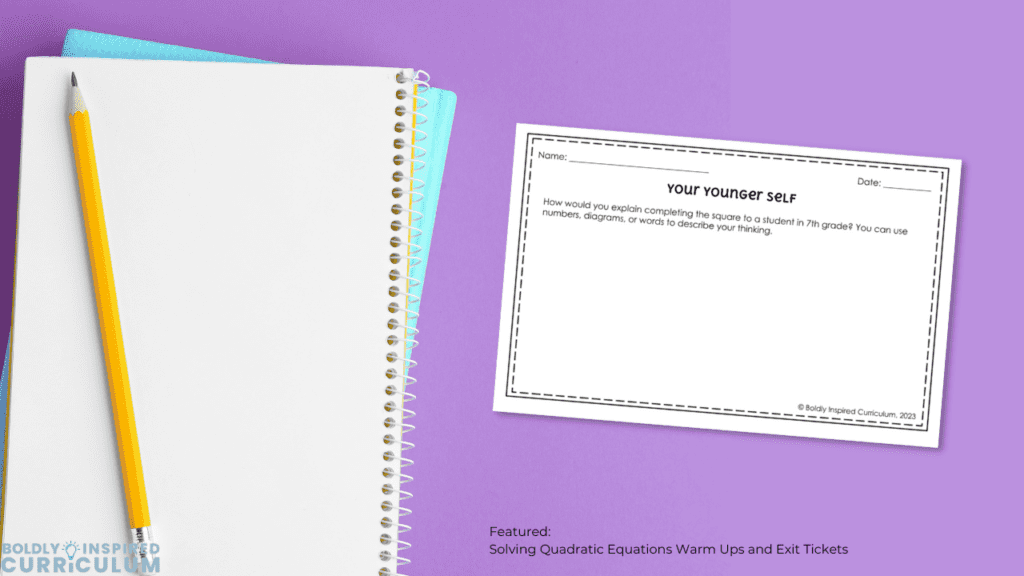
"Convince Me" Questions
After solving, students must prove their answer is correct using words, diagrams, or models. It pushes them beyond “because I got it.”
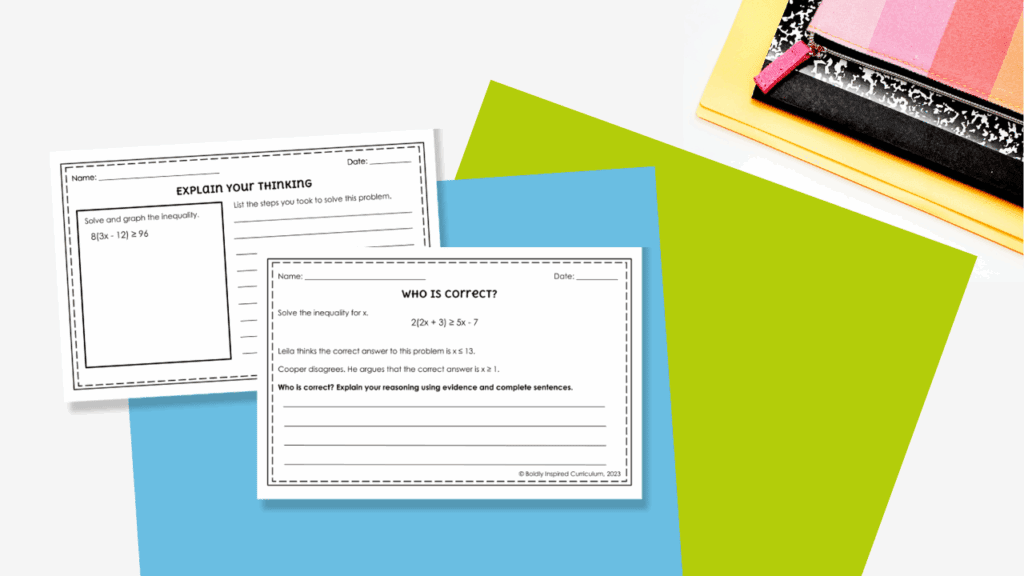
Open-Ended Problems
Ask questions with more than one correct answer or strategy. Students learn that math isn’t just one rigid pathway.
Classroom Example
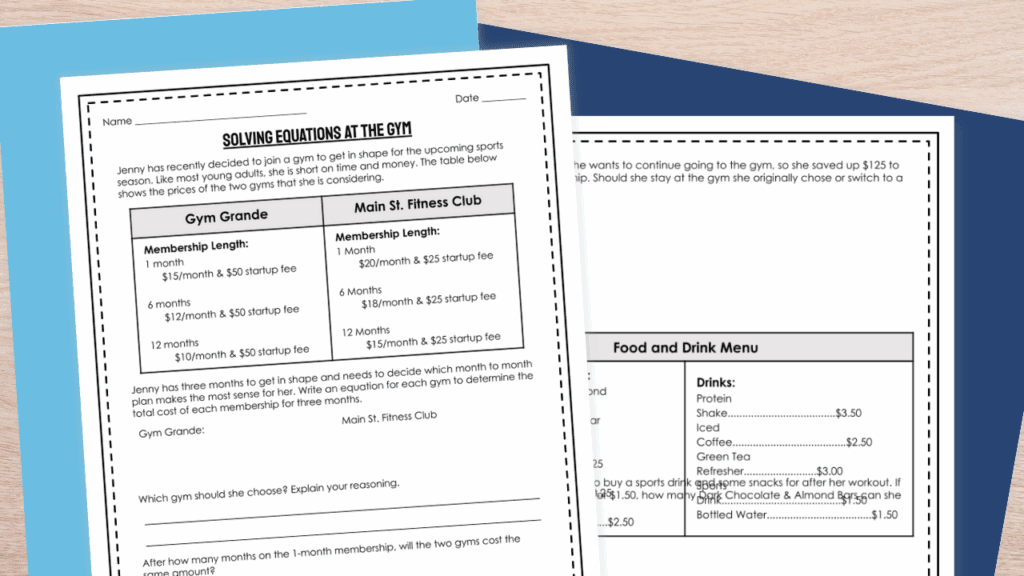
One of my favorite math problem solving activities for 8th grade and Algebra 1 is a multi-step equations task where students write equations from real contexts, then solve and explain their what the solution means. Instead of being handed the math, they must create the math first. This small shift of modeling before solving dramatically improves students’ confidence with word problems and multi-step equations.
How to Make ANY Activity More Problem Solving Focused
Turning a traditional worksheet into a true problem-solving task shouldn’t require a full curriculum overhaul. You really just need to look at how small shifts in the questions you are asking can impact your students’ need for problem solving.
Start by asking students to explain their reasoning in words, not just show steps, so they’re forced to think about the why behind each move. Encourage them to try more than one strategy or representation, like solving with a table and an equation, so they build flexibility instead of relying on a single method.
You can also design prompts that feel open-ended or have multiple reasonable approaches, which helps students see math as something to explore rather than something to guess the teacher’s answer to.
Most importantly, build reflection into the routine. After solving, ask questions like “How do you know this makes sense?” or “Would this always work?” to push students beyond computation and into justification.
These quick conversations help students connect their answers back to the context and catch mistakes on their own. Over time, these habits turn everyday practice into meaningful thinking, and that’s what truly strengthens problem-solving skills.
Final Thoughts about These Math Problem Solving Activities
If you want stronger problem solvers, you don’t need more worksheets. You need more opportunities for students to think, talk, model, and justify.
Try adding just one or two of these math problem solving activities each week. Over time, you’ll notice something powerful: students stop asking, “What formula do I use?” and start asking, “What makes sense here?”
If you want ready-made real-world tasks that follow this structure, check out all of my real world math tasks for middle and high school!