
Let’s talk about the elephant in the room: AI cheating.
If you’ve ever graded a set of assignments and thought, “Where did these subscripts come from?” or “Why are they putting an x in between polynomial expressions, when we’ve never written them that way?, you’re not imagining things. Between ChatGPT, photo math apps, and equation solvers, students now have tools that can generate answers in seconds.
And honestly? Trying to block every tool or police every assignment is exhausting. But here’s the good news: you don’t have to outsmart AI.
You just need to design lessons that make thinking impossible to outsource.
When we shift from answer-getting to reasoning, modeling, and explaining, AI cheating becomes a lot less useful and much less tempting.
Here’s how to AI-proof your math lessons without reinventing your entire curriculum.
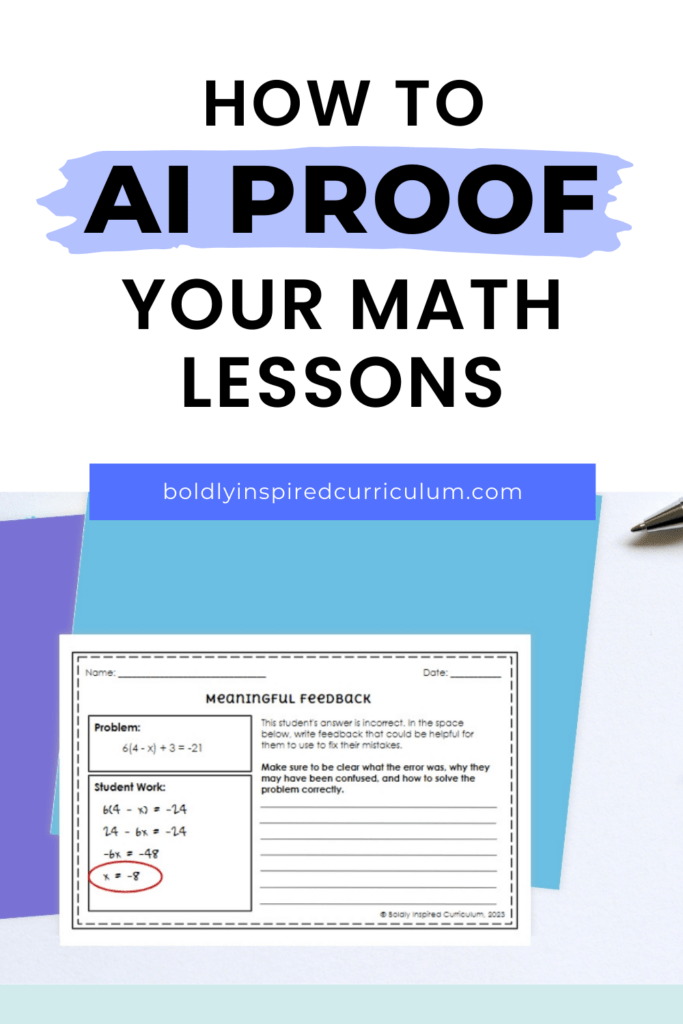
Table of Contents
ToggleRethink the Goal of the Assignment
Most AI cheating happens when tasks only require a final answer. If the question is asking students to solve for x, AI can do that instantly.
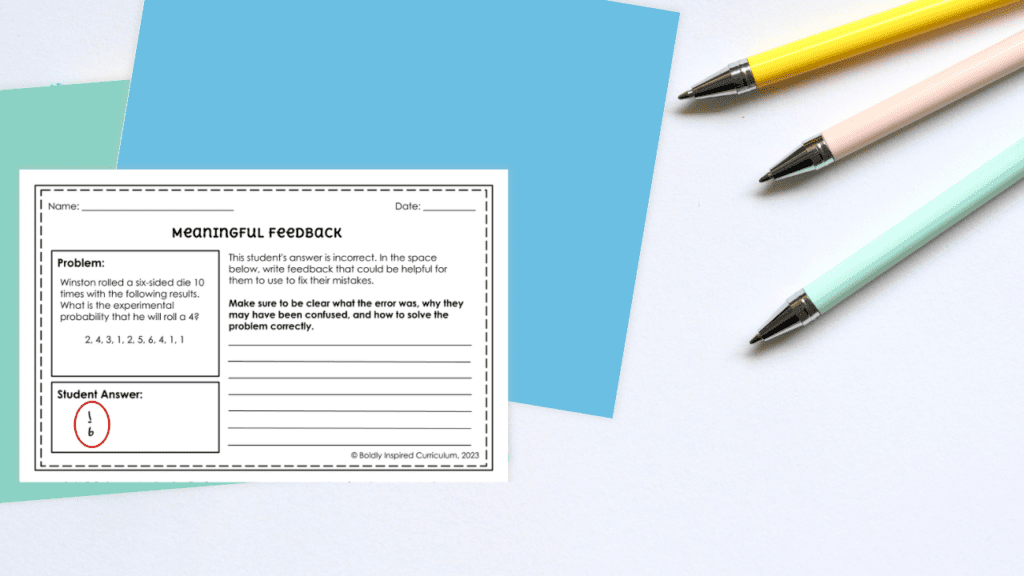
But if the task is to model this situation, choose a strategy, justify your thinking, and explain why their answer makes sense, your students actually have to think.
AI is great at producing solutions. It’s much worse at showing authentic reasoning, messy thinking, and personal decision-making.
The goal here isn’t “harder problems.” It’s deeper thinking.
7 Practical Ways to AI-Proof Your Lessons
These strategies work with what you already teach, but adjust how students engage with it.
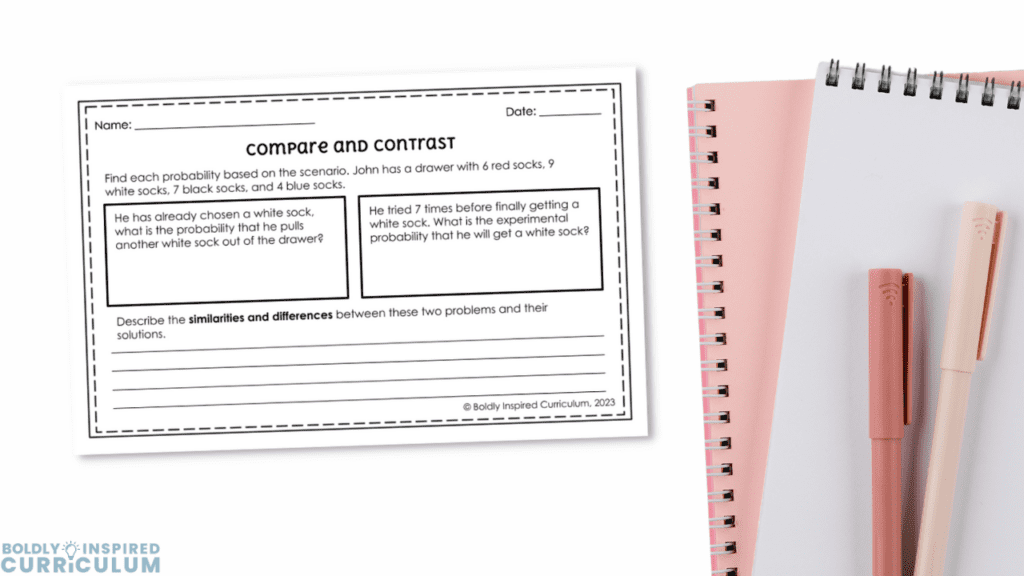
Ask for Explanations, Not Just Answers
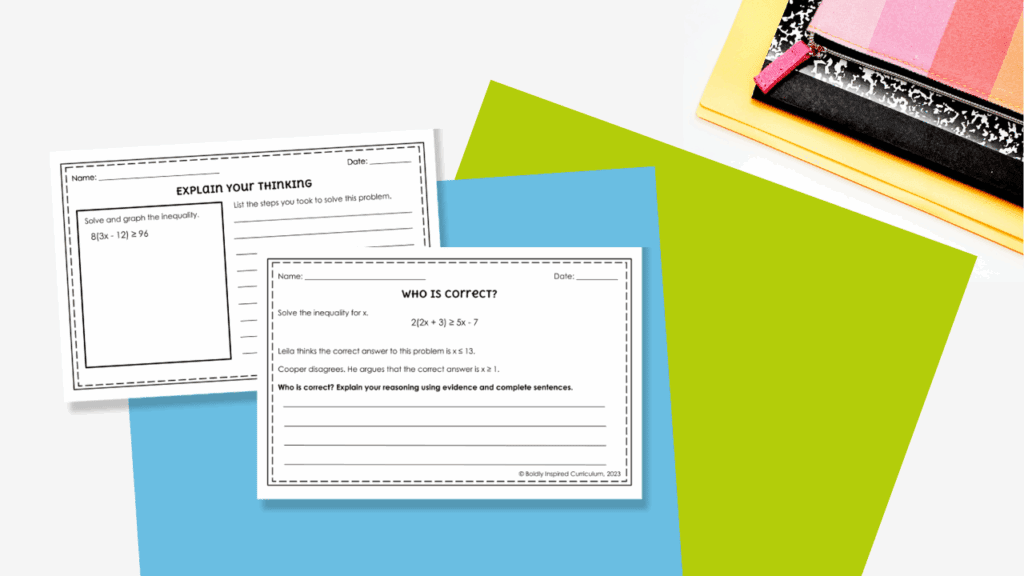
Require students to explain why their solution works in words. A short written or verbal justification reveals real understanding in a way copied answers can’t.
Use Real World Contexts
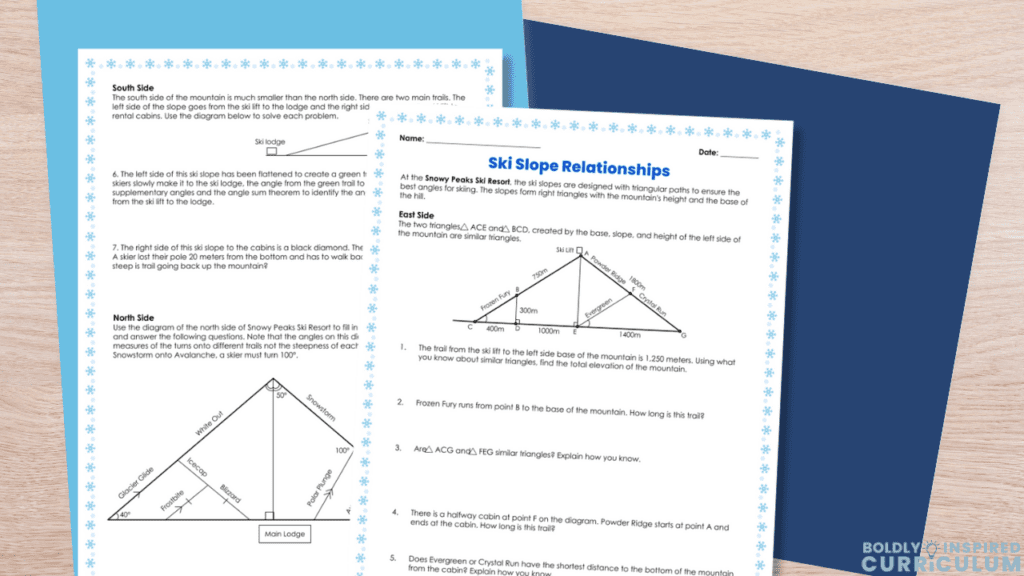
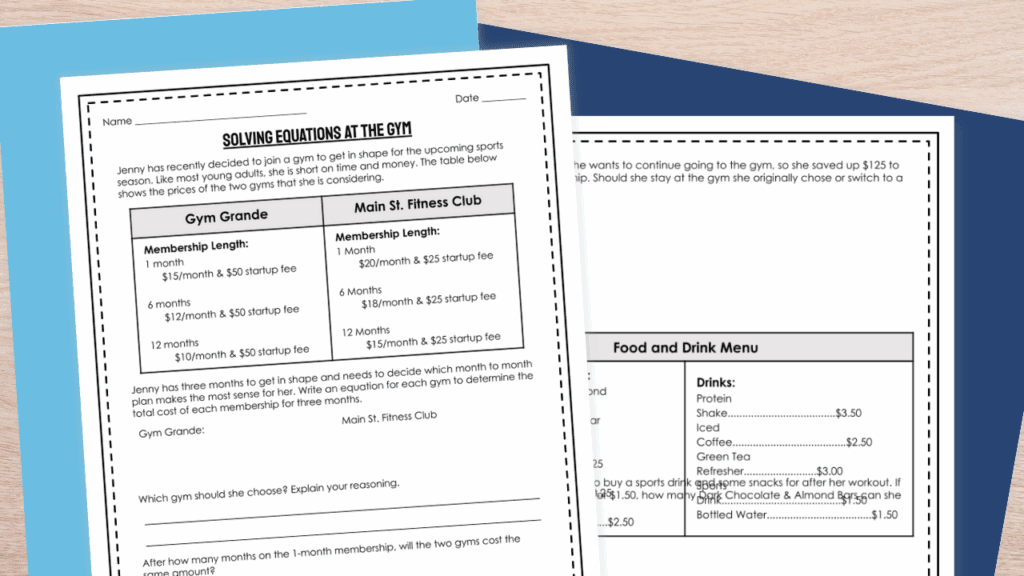
When problems connect to realistic situations, students must interpret and make decisions, not just compute. AI can solve equations, but it struggles with authentic context-specific reasoning and classroom discussion.
Have Students Show Multiple Strategies
Ask for two different methods (table and graph, graph and equation, etc.). This pushes flexible thinking and makes quick copy-paste solutions less effective.
Incorporate Class Discussions
Build in think-pair-share or partner talks. When students regularly explain ideas out loud, it’s easier to see who understands and who needs support.
Include Reflection Questions
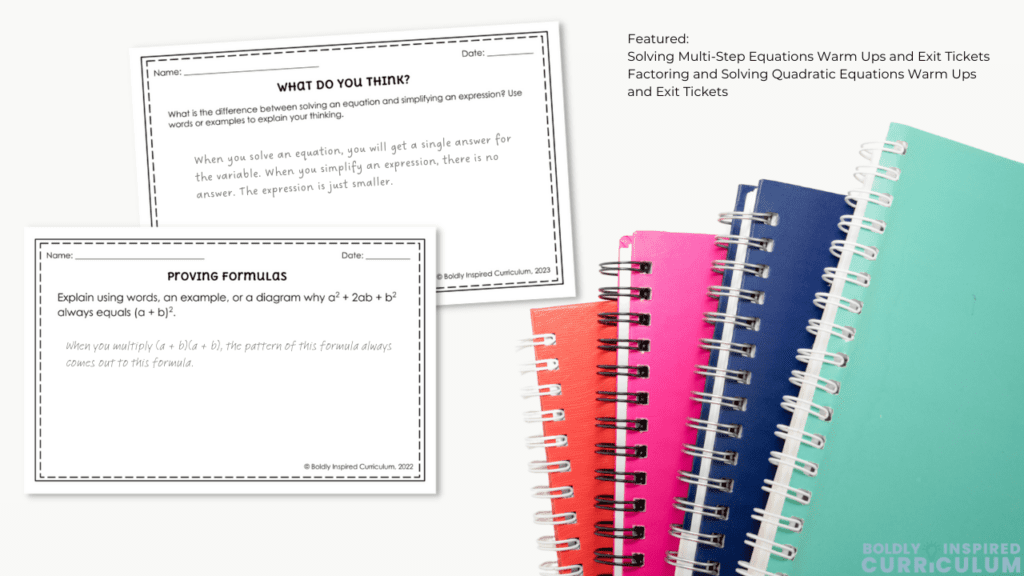
Add prompts like:
Why does this answer make sense?
What would happen if the number changed?
How do you know your strategy works?
These questions force deeper processing that AI can’t easily fake.
Use Open-Ended Tasks
Give problems with multiple correct answers or solution paths. When students create or design something, there’s no single “Googleable” response.
Do More In Class Work
Short problem-solving activities, stations, or whiteboard tasks let you observe thinking in real time. It’s much harder for AI cheating to happen when the work happens in front of you.
What This Looks Like in Practice
Before/After Example
Instead of assigning 20 routine problems for homework, try this:
Give students a short real-world scenario and ask them to write an equation, solve it, and explain what the solution means.
Then, have students compare strategies with a partner so they can analyze different modeling strategies, solution paths, and interpretations. This addresses the same math standards, but pushes students to see beyond just the numerical answer.
With these strategies, students are modeling, reasoning, and communicating, which is something an AI tool can convincingly replace.
A Mindset Shift That Changes Everything
Here’s the part that might feel counterintuitive: The solution to AI cheating isn’t stricter rules. It’s better questions.
When assignments are meaningful, collaborative, and reasoning-based, students are less likely to cheat in the first place. They feel ownership. They talk through ideas. They actually understand what they’re doing.
Plus, you get richer insights into their thinking instead of trying to play detective with suspiciously perfect answers.
Start Small (You Don't Need a Complete Overhaul)
You don’t need to redesign every lesson tomorrow. Tiny shifts can add up fast. Start with one simple change this week:
- Add one explanation question
- Turn five problems into a partner task
- Ask students to create their own word problem
- Replace a worksheet with task cards or stations
Final Thoughts
AI tools aren’t going away. If anything, they’re getting better. But here’s the thing: math class was never supposed to be about getting answers the fastest. It’s about reasoning, problem solving, and making sense of the world.
When we design lessons around those skills, AI cheating stops being the threat it feels like. There’s nothing meaningful for AI to replace. And honestly? That’s better teaching anyway.