
Projects and real world applications in math class will take your students from standard surface level learning to deep critical thinking. By making math relevant for your students you’re not only increasing their buy-in but you’re teaching them skills that they’ll need for the future. This Algebra 2 project connects graphs of polynomial functions to a real life scenario.
I’ve found that it’s relatively simple to relate lower level math to the real world. You can easily relate simple operations and equations to everyday activities like shopping or cooking.
However, when you start teaching upper level math classes to high school students it’s harder for them to see the relationship that math has to their life. Yes, there are a lot of ways to relate Algebra 2, Precalculus, and Calculus to physics and other science related topics but a lot of the time those topics are going to go right over your students head.
Ideally, the real world applications that you’re giving to your students are going to be ones that they can wrap their heads around. In this blog post I am sharing one of my favorite end of year projects to do with my Algebra 2 students.
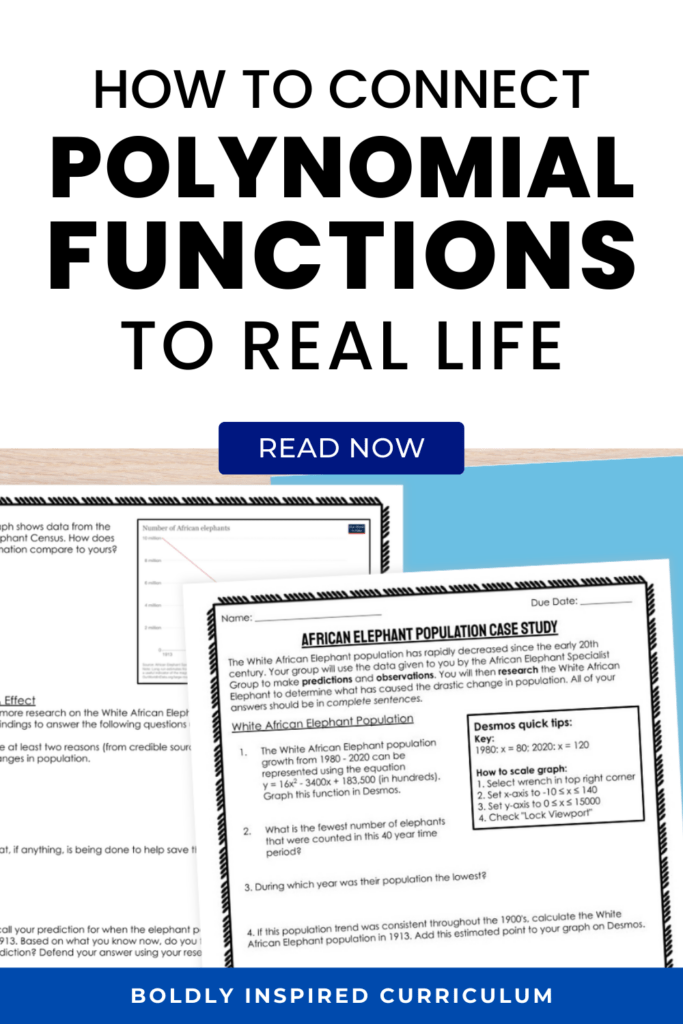
Table of Contents
ToggleHow This Polynomial Functions Project Works
This resource isn’t just a one-day assignment. It’s a guided project that gives students the time and structure they need to engage deeply with different graphs of polynomial functions.
What's the scenario?
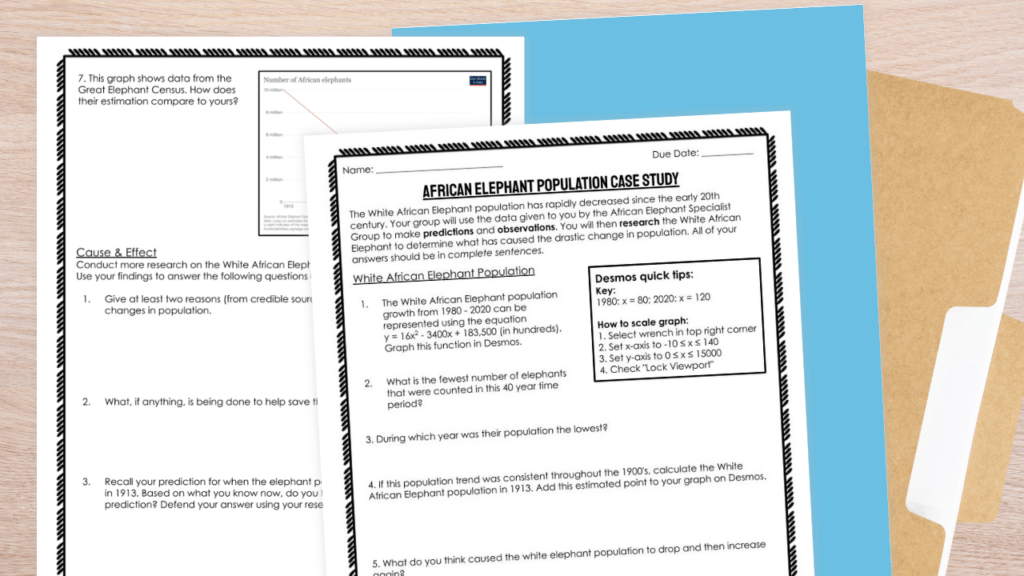
This real world application centers around elephant and Rhino population changes throughout the 1900s. All of the data in this project comes directly from The African Elephant specialist group and the African and Asian Rhino specialist groups. Each of the scenarios shows a real graph of the population changes for different species of elephants and rhinos which directly relate to a function.
5 Graphs of Polynomial Functions to Analyze
Students will explore a variety of graphs representing polynomial functions with different degrees, end behavior, and turning points. There is a combination of linear, exponential, and polynomial functions featured within the five scenarios.
Your students will have the choice of five different breeds to research and analyze population changes. They will then use the function provided in this application and the Desmos graphing calculator to compare their predictions to the actual graph. (Don’t worry. There are instructions for using the Desmos graphing calculator!)
How to Grade This Project
This project has multiple versions and a variety of uses. Teacher directions are included to walk you through each way that this activity can be used in your classroom.
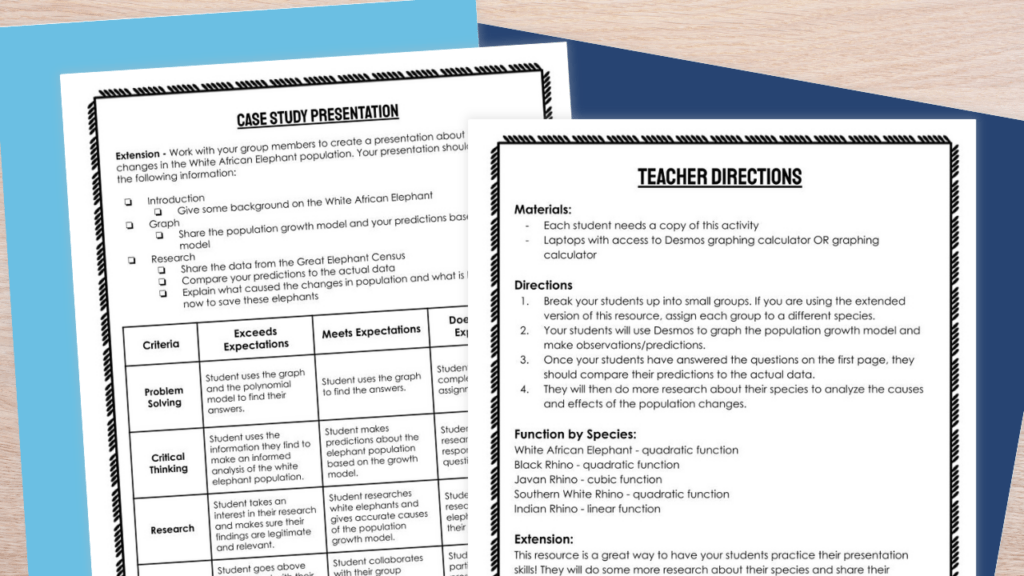
It includes a grading rubric that will help you assess your students’ understanding of the material as well as problem solving skills. This rubric is flexible, so you can assign points based on your specific grading system.
How to Extend This Activity
You can extend this project even further by having your students present about their research and how the given function compares to the actual data. There are additional directions included for this resource if you decide to use it as a group project.
Ways to Use This Polynomial Functions Project in Your Classroom
End of Year Review
Assign the entire packet over a week as a cumulative, guided review. Great for post-test or exam-week schedules.
Group project
Lorem ipsum dolor sit amet, consectetur adipiscing elit. Ut elit tellus, luctus nec ullamcorper mattis, pulvinar dapibus leo.
Individual assessment
Use this as an alternative to a traditional test or quiz. It allows students to demonstrate conceptual understanding in a more open-ended, student-friendly format. You can also extend this activity by having your students create a presentation about their specific breed and what they observed from the data.
Emergency Sub Plans
This project should take more than one day. If you are out for one day, you can assign it the day before and let your students ask you questions. That way, when the sub is in your class, your students already know what they need to do!
Final Thoughts About This Polynomial Functions Project
Most word problems have one question that needs to be answered and little follow up or detail. This real world math activity stretches one idea or scenario into a meaningful performance task that can be used as a full assessment of student learning.
Your students will be challenged to think critically about each scenario and defend their solutions. This Algebra 2 polynomial functions project is more than just busywork. It’s a thoughtful, classroom-tested way to bring purpose and engagement to your functions unit.