
Does this sound familiar? Students stroll into your classroom chatting, backpacks hit the floor, someone asks what page we’re on, someone else forgot their pencil again, and you’re fielding five questions at once before the bell even rings. Those first five minutes change everything.
Math warm ups set the tone. They anchor the class. They give students a predictable routine that makes the transition from hallway chaos to focused learning feel effortless. In middle and high school math, where concepts build quickly and confidence matters, those few minutes at the beginning and end of class are some of the most valuable instructional minutes you have.
Table of Contents
ToggleThe Benefits of Daily Math Warm Ups
Math warm ups are more than just busywork. They create consistency, which students crave sometimes more than we realize. When students know exactly what to expect when they walk into the room, they are more relaxed which ultimately helps settle your classroom faster.
Instead of redirecting behavior or repeating, “Please take out your notebook,” you can use those minutes to check in with students, take attendance, or prep materials while the class is already engaged.
Reinforce Key Skills
If students only practice a skill during a single unit, it rarely sticks. Warm-ups cycle students through skills they’ve learned all year long, like solving equations, interpreting graphs, simplifying expressions, so that the remembering happens naturally and continuously.
Build Independent Thinking
A well-designed warm-up gives students a chance to think on their own before you teach or review. These short tasks help students build stamina, problem-solving skills, and a willingness to try, especially when the prompts require them to explain their reasoning or analyze mistakes.
Save Time and Create Smoother Transitions
Warm-ups eliminate the “settling in” time that can eat away at 5–10 minutes of instruction. When students begin each class with a familiar routine, transitions become easier, behavior issues decrease, and you gain valuable instructional minutes back.
What Makes A Good Warm Up?
Not all warm-ups are created equal and the best ones strike a balance between clarity and challenge.
Strong math warm ups are…
Clear and Simple
Students should be able to start without clarification. The warm-up shouldn’t feel like an entire assignment. It should be quick and focused.
Purposeful
Warm-ups work best when they’re tied to a specific skill or math practice. They can review previous content, preview upcoming lessons, or simply strengthen foundational algebra skills.
Thought-Provoking
The best warm-ups push students to think deeper, not just “compute.” Writing prompts, error analysis, and short reasoning tasks all encourage students to explain why, not just what.
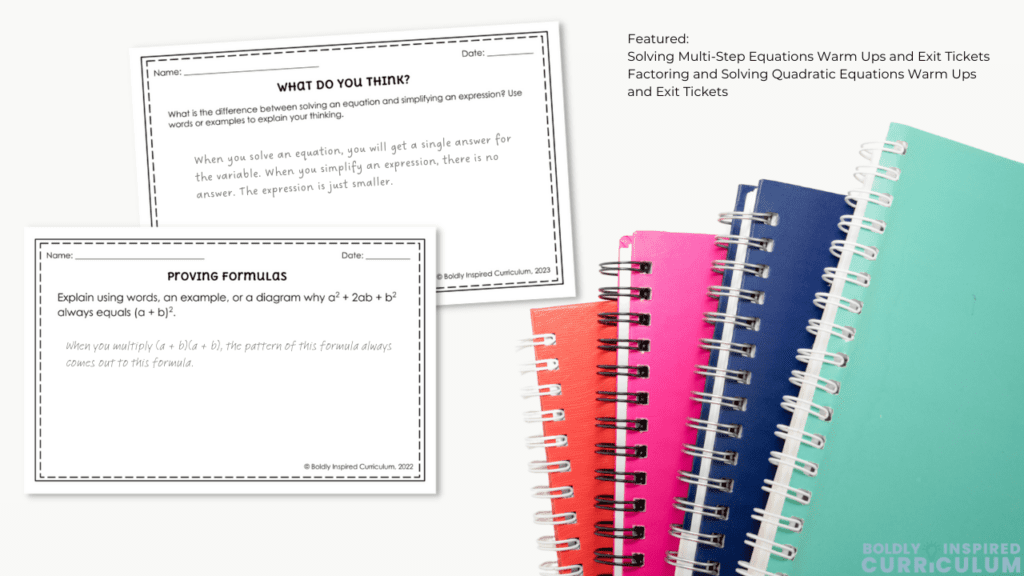
This is why I intentionally design my Algebra 1 warm-ups to include math writing, reflection, and critical thinking. These are skills that often get overlooked but make a massive difference in students’ long-term understanding.
Tips for Implementing Math Warm Ups Successfully
Bell Ringers, Exit Tickets, or Both
Warm-ups work beautifully at the start of class, but they’re just as effective for closing routines. Exit tickets help you diagnose misconceptions quickly and plan the next day’s instruction.
Rotate Between Procedural and Critical Thinking Tasks
A mix keeps students on their toes. Some days can be computational, others can be reasoning-based, and some can involve writing prompts. This variation helps build a fuller picture of student understanding.
Keep Routines Consistent
Consistency reduces student anxiety and helps build habits. Even if the content changes, the structure should stay predictable so students know exactly what to do.
Math Warm-Up Ideas for Any Topic
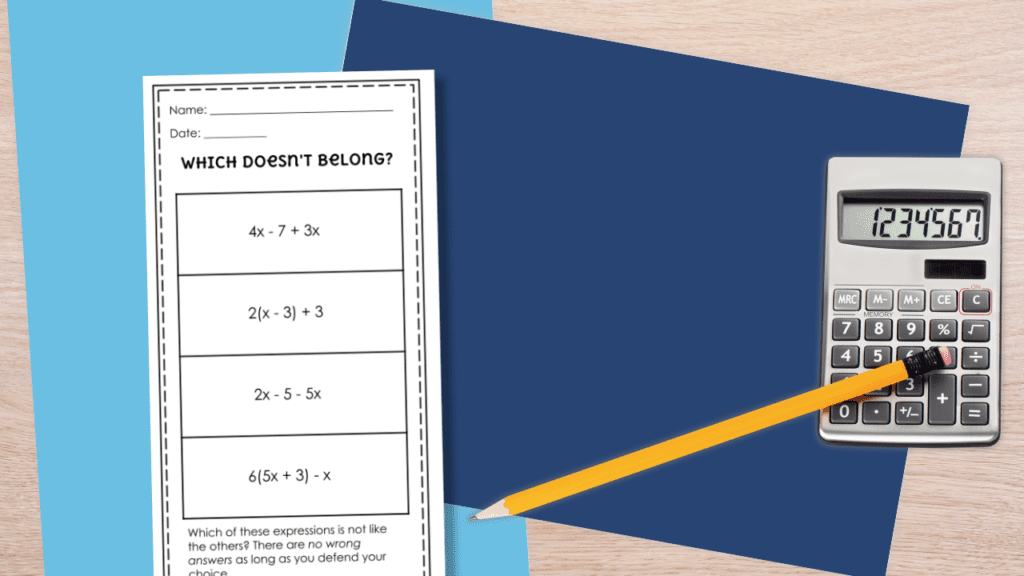
Which Doesn't Belong
A key benefit of “Which Doesn’t Belong?” questions is that they have no single correct answer. This low-stakes question encourages students to think flexibly, consider multiple perspectives, and practice defending their reasoning. A great closing question for the discussion is to ask students if anyone’s mind was changed and, if so, why.
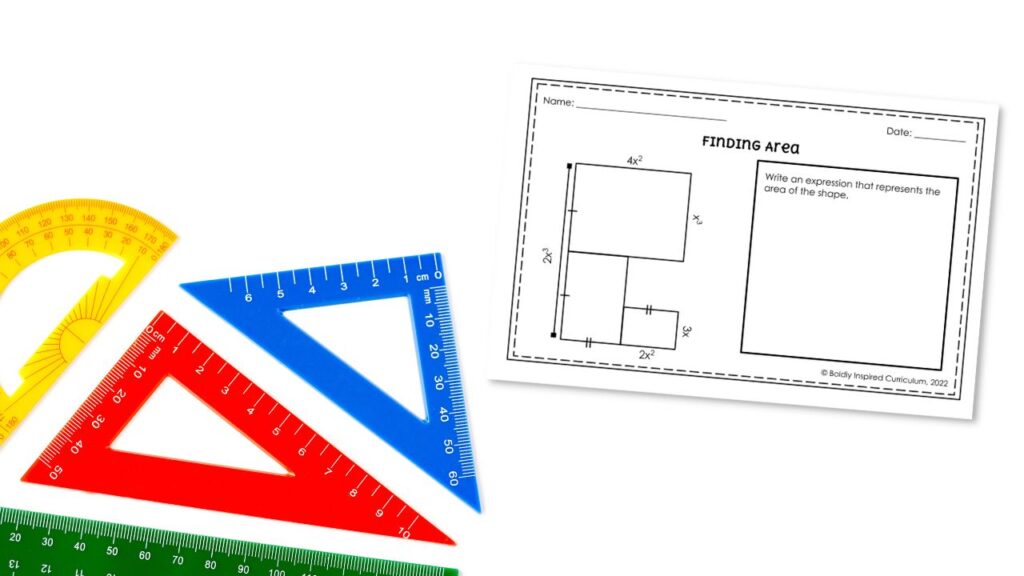
Problem Solving
A problem-solving writing prompt should encourage students to find multiple solutions or model the problem in diverse ways. For instance, a task could involve using algebra tiles to represent expressions. Students would then need to explain how the tiles accurately model both the initial problem and the resulting solution.
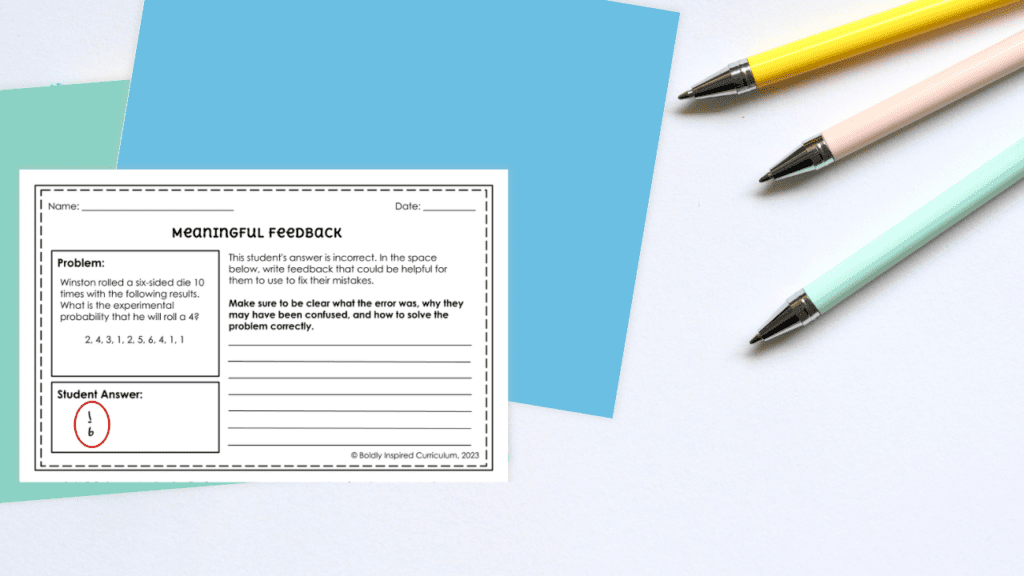
Error Analysis
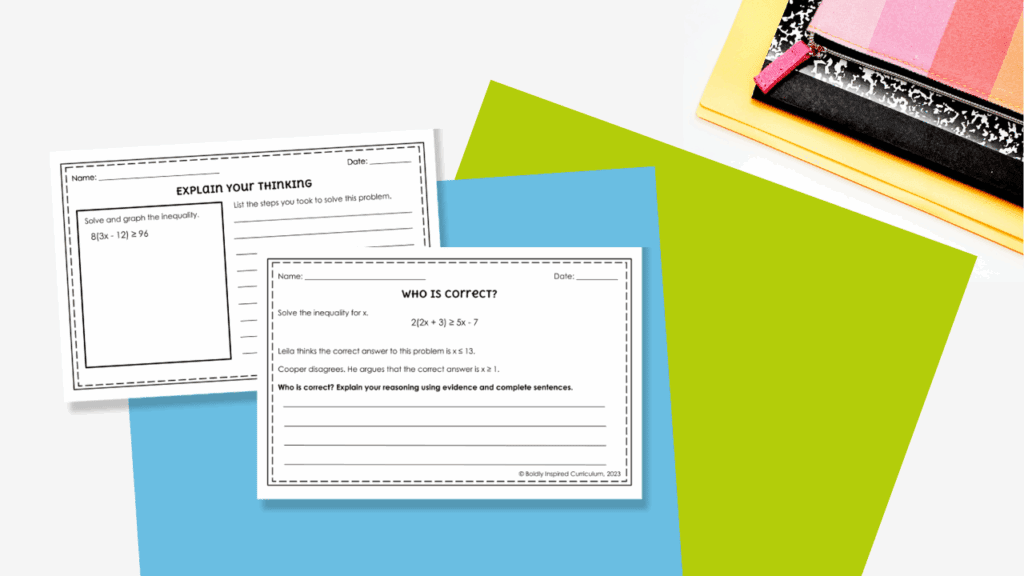
Give students a mathematical statement or solution that contains an error and ask them to identify and explain the error. This will start your class with a meaningful discussion and get your students thinking (and talking) about math.
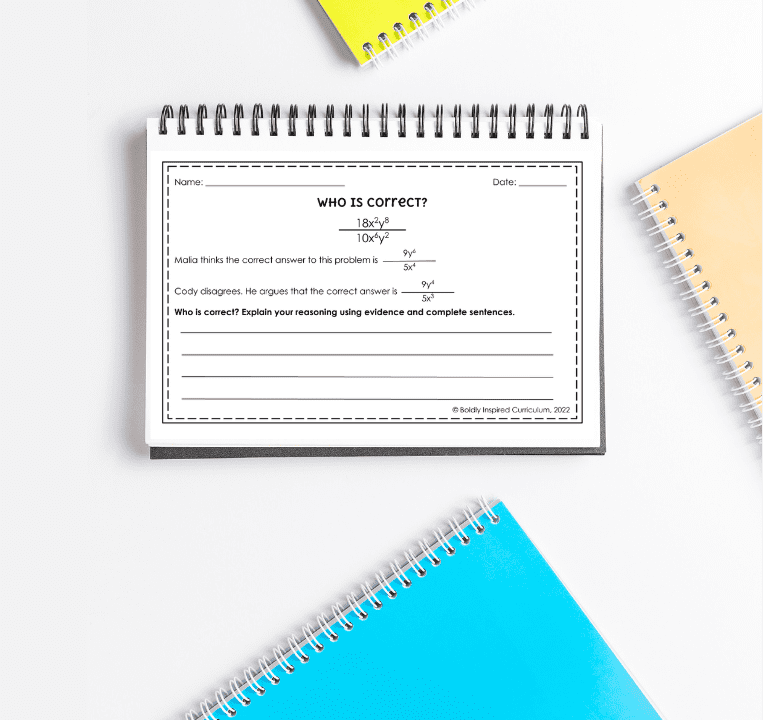
Who Is Correct?
These types of questions are similar to error analysis prompts except students will be given two options for possible solutions. They will then have to choose which student has the correct answer and explain why. The added step here is asking your students to explain how they know which answer is correct and to identify the mistake in the other answer.
Final Thoughts About Math Warm Ups
All of these ideas (and dozens more!) are included in my Algebra 1 Warm-Up and Exit Ticket Bundle, which provides a full year of ready-to-use, print-and-go prompts.
Each warm-up is intentionally designed to make students write about math, explain their thinking, and revisit essential Algebra skills all year long. Teachers love using these as bell ringers, test prep, quick checks, and even as sub plans because they require zero prep and spark meaningful math conversations.
Math warm ups are small, but their impact is big. They anchor your classroom routine, strengthen core skills, and build confident, independent thinkers without adding more prep to your plate.