
There’s no denying that linear equations can be easily related to so many real life scenarios. This linear equations project is just what your students need to show mastery of writing and graphing functions, whether you want to use this project for a summative assessment, a group project or extra credit.
Real-world projects like this aren’t just made to change things up in your math classroom. They’re essential for helping students connect math to life outside the classroom making it that much more meaningful. Instead of memorizing slope and intercept as abstract terms, they begin to understand what those values actually represent and how they can be applied to real life scenarios.
This linear equations project pushes students beyond simply graphing lines and writing equations in standard form. It challenges them to analyze, compare, and justify their reasoning, building strong critical thinking skills along the way. Writing components encourage students to put their thought process into words, which not only strengthens math communication but also deepens their understanding. Even students who typically struggle with abstract math often become more invested when they see the value of their work in a concrete situation.

Table of Contents
ToggleWhat the Project Is and How It Works
This linear equations project is about helping students write, graph, and interpret linear functions in real situations. Students are asked to model a scenario, like predicting costs, analyzing trends, or comparing options, and then show their reasoning through tables, equations, and graphs.
Here’s what students will do:
- Write equations in slope-intercept form, standard form, and point-slope form
- Graph their equations and interpret the slope and intercepts in context
- Rewrite literal equations
- Compare different equations to analyze decisions
- Write about their thinking and justify their conclusions.

What's the scenario?
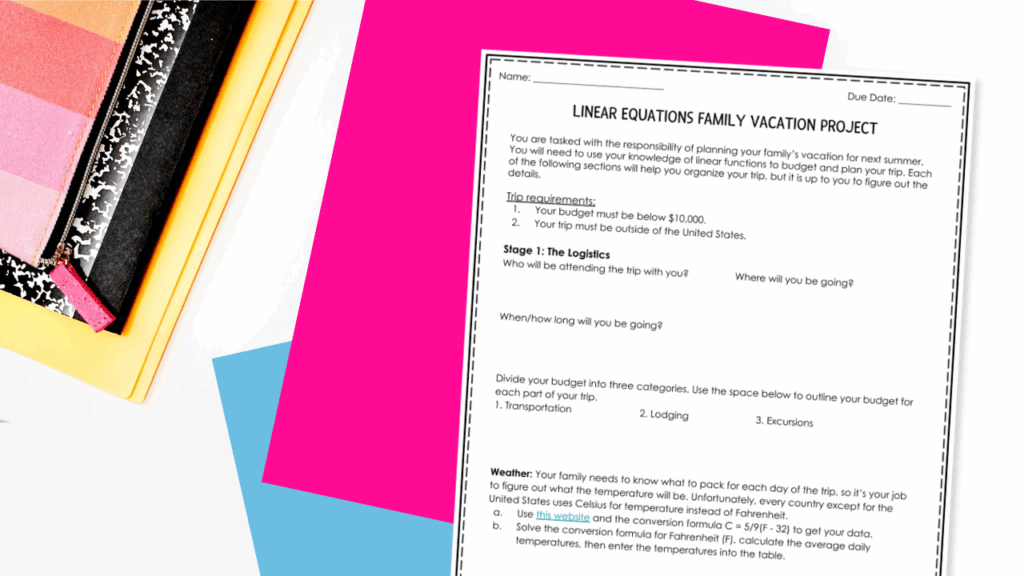
You are tasked with the responsibility of planning your family’s vacation for next summer. You will need to use your knowledge of linear functions to budget and plan your trip. Each of the following sections will help you organize your trip, but it is up to you to figure out the details.
Part 1
The first part of this linear equations project is the logistics. Your students are given a $10,000 budget to plan a family vacation and they need to decide who they will bring with them, where they are going, and how long they will be staying. They will then take their $10,000 budget and divide it into three sections: travel, lodging, and excursions.
The trip they plan must be international so the first calculation they need to make is converting the temperature from Celsius to Fahrenheit. They will rewrite the Celsius to Fahrenheit formula and create a table based on their planning vacation days.
Part 2
Now that they have the logistics in order, they can begin to plan their travel. Every good traveler knows that you don’t just choose the first option for travel services. Your students will need to determine how they are going to get to their destination and compare two different transportation companies.
For example, if they are planning to fly they will need to compare pricing for two different airlines. However, they don’t necessarily need to make their decision based off of price along. They may end up choosing the more expensive airline because it offers non-stop flights. The goal of this section is to weigh the pros and cons of each company and justify their reasoning for choosing one over the other.
Your student will also make calculations for a rental car and compare pricing based on the number of days that they plan to rent a car. This problem has questions that require your students to write the linear equation in standard form and identify x and y intercepts.
Part 3
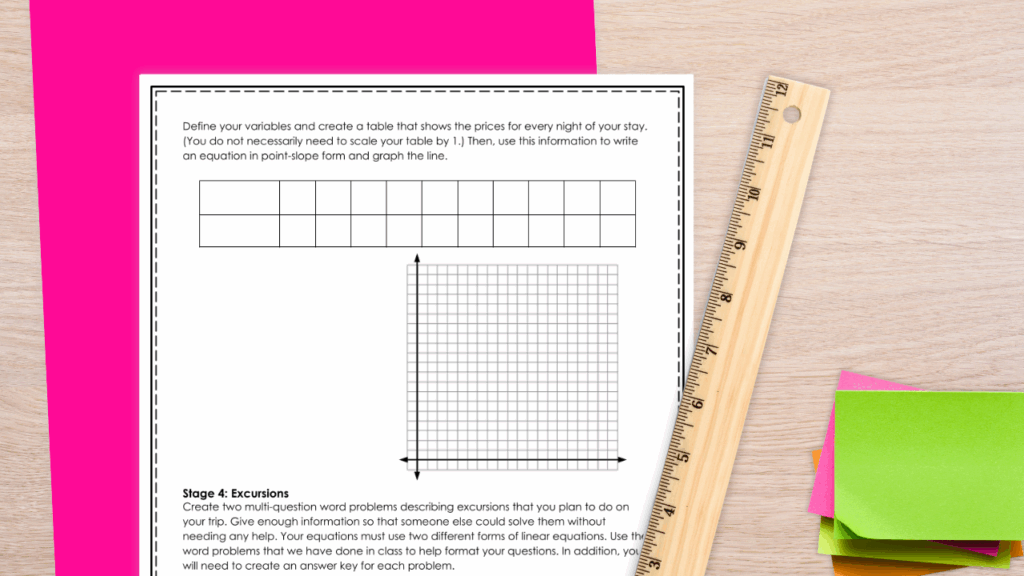
Part 3 covers lodging. Your students will need to determine how many rooms that they need based on the number of people that are going on their trip with them. They will create a table based on the number of nights that they plan to stay and the total cost for all of the rooms. Once they’ve created the table, they will write an equation in point slope form and graph it.
Part 4
Part 4 of this linear equations project is designed to be an extension for early finishers or extra credit. However, you can also include it as part of the full assessment. Your students will need to plan two excursions while they are on their trip and create two word problems based on these excursions. Once they create the word problems they will need to make an answer key and solve each problems.
Ways to use this project in your Algebra 1 classroom
Early finishers
I have used this as an extra credit project throughout the entire linear functions unit for my early finishers. I typically have a few students in my heterogenous Algebra 1 classes that always finish their work early and are looking for ways to bring their grade up.
This project was perfect for them to start at the beginning of the unit and pull out any time they were done with their work. By the end of the unit, they had completed the project and were able to get extra credit!
Small group
Your students can work together to complete this activity and have discussions about different strategies for writing expressions from graphs and tables. Open ended projects like this one can often be challenging for students. Having a small group or even a partner to bounce ideas off of can make a huge difference if you’re looking to easily differentiate.
Individual
I have used this activity as an assessment for my Algebra 1 students. It usually takes them about 3-4 class periods to complete on their own and always keeps students engaged. This is also a great option for sub plans if you know that you are going to be out. Have them start the first day while you are in class. When the sub comes in the next day, they will already know what they need to do and can start working on it right away.
How to Assess the Project
I have used this activity as an assessment for my Algebra 1 students. It usually takes them about 3-4 class periods to complete on their own and always keeps students engaged. This is also a great option for sub plans if you know that you are going to be out. Have them start the first day while you are in class. When the sub comes in the next day, they will already know what they need to do and can start working on it right away.
Why Teachers Love This Resource
This linear equations project was designed with teachers in mind:
- It’s ready to use. No extra prep required: just print and go!
- It’s student-friendly. You’ll be able to connect abstract math to something concrete (and relevant).
- It’s ready to use. No extra prep required: just print and go!


Ready to try it?
If you’re looking for a way to make linear equations meaningful in your Algebra 1 class, this project is for you. It’s designed to save you time while giving your students the kind of hands-on, real-world math experience they need.
Let’s give students a reason to see math as more than just numbers on a page.