Contrary to popular belief, math accommodations, modifications, and adaptations are not all the same. As regular education teachers, we don’t get a lot of training on special education just in our undergraduate degree programs. We’re pretty much left to figure it all out along the way.
This means when teachers get pulled into IEP meetings to give their perspective on the student’s progress, strengths, and weaknesses in their class. After everyone gives their perspective, the meeting turns into a whole bunch of confusing educational and psychological jargon.
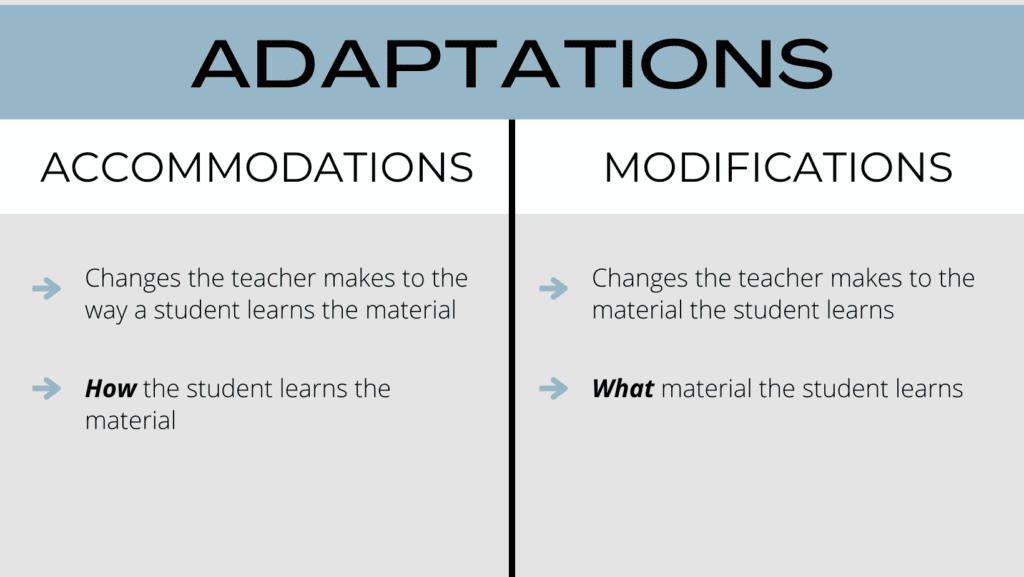
In math, the terms accommodations, modifications, and adaptations are commonly used interchangeably, when in reality, they all have their own meaning and purpose in the classroom. In this case, adaptations is the overarching term for both accommodations and modifications.
Table of Contents
ToggleCommon Math Accommodations
Accommodations are defined as changes a teacher makes to the way a topic is taught or delivered. The important piece of this to note is that math accommodations does not change the curriculum. They simply change how a student might learn the same content. Keep reading for examples of what this could look like in your math classroom.
Alternate Testing Room
Students with sensory or attentional challenges really benefit from being in a quiet space and a different environment.
Extra Time for Assessments
Sometimes students struggle with feeling rushed on assignments and just need a little extra time to work through their thinking. Offering time and a half on assessments can make a huge difference for many students who have IEPs or 504s.
Support Teachers
If you’re lucky enough to have paraprofessionals or teacher aides in your classroom, be sure to use them to their full potential! Having an extra set of hands to keep students on track or answer questions is a game changer.
Preferential Seating
This could look like sitting at the front of the room or next to a support teacher.
Notecards and Reference Sheets
Many students struggle with memorization or task initiation, so teachers can allow select students (or entire classes) to create a resource that they can reference during an assessment. Check out these math reference posters
Common Math Modifications
Modifications are changes that teachers make to the curriculum, so that it is more accessible to special education students. These are much less common than math accommodations because the outcomes of the course have changed.
Leveled Math Classes
There may be slower paced or alternate classes that special education students can take while still being able to earn the same credit.
Simpler Math Problems
For example, if the class is learning about solving equations, the student who needs modifications may solve problems with variables only on one side of the equation rather than both.
Sectioning Different Types of Questions on a Quiz
Explicit directions for each question is essential for helping students complete work independently and figure out where to start.