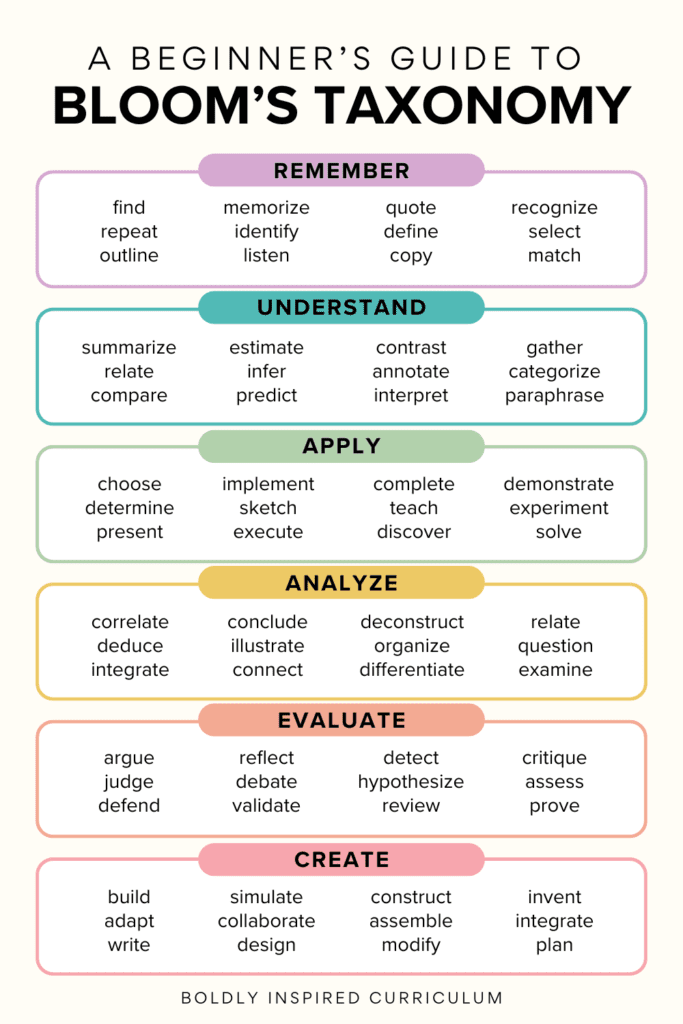
Bloom’s Taxonomy verbs are frequently taught in educator preparation classes as a way to ensure that teachers vary the skills that students are being asked to show through different lessons.
This framework was created to categorize cognitive functions and use these categories to outline learning objectives. In math classrooms, Bloom’s Taxonomy verbs can be a powerful guide for moving students from simply memorizing formulas to applying them in word problems and justifying their reasoning.
Let’s dive into the types of activities that can be used for each level of this framework.
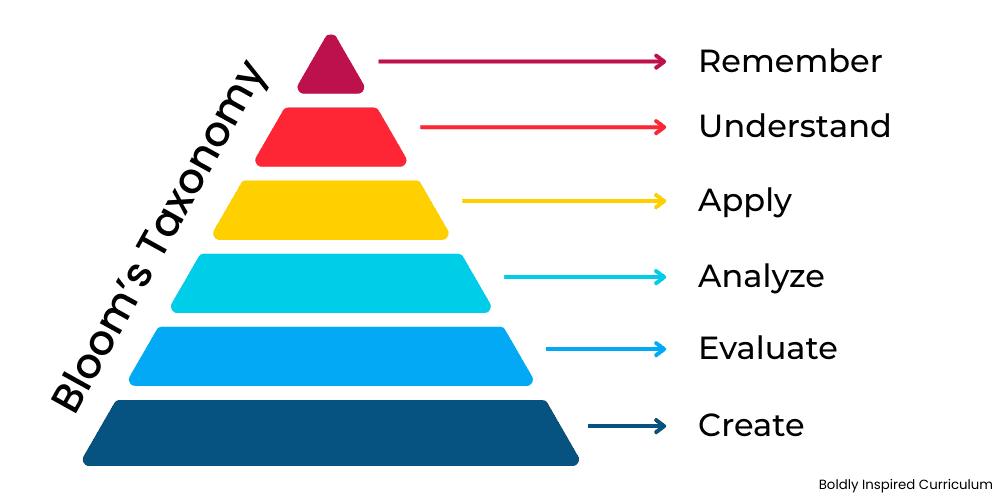
Table of Contents
Toggle1. Remember (recall facts and basic concepts)
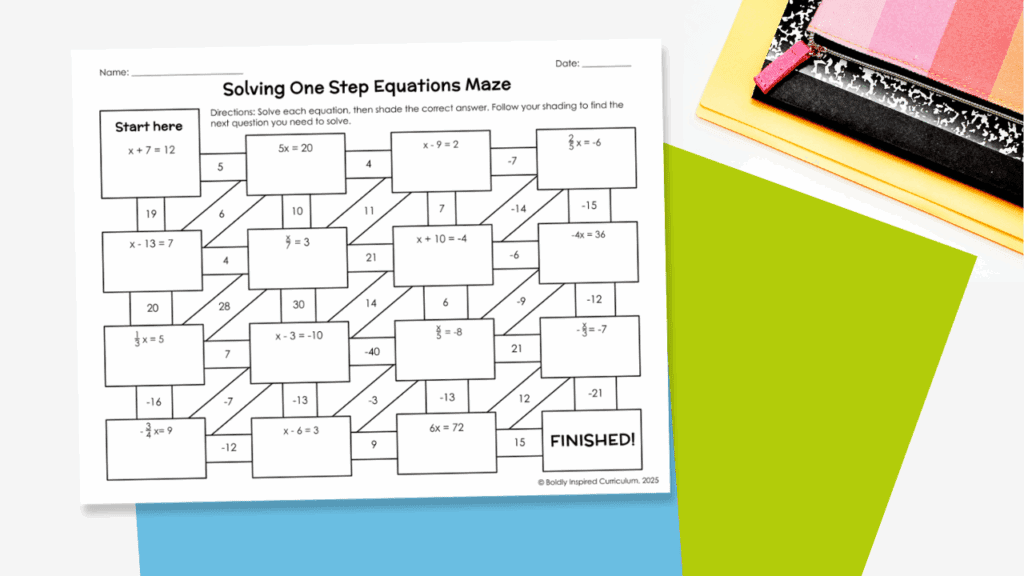
This level is the most basic skill in the pyramid, but where your students will be practicing the most. This is the phase where they will practice skills and concepts, such as math facts, exponent rules, and one step equations, repetitively until they are solving problems almost automatically.
The remember stage truly builds the foundation for the rest of the skills in the Bloom’s Taxonomy verbs pyramid. Your students must feel confident at this foundational level before they are ready to move up to higher order thinking.
At this level, your classroom activities should focus on repetition, memorization, and quick recall. Worksheets, flash cards, and math fact games give students structured practice, while whiteboard problem solving and exit tickets let you quickly check their progress. Even fun challenges like math escape rooms can reinforce basic skills while keeping engagement high.
While it may feel “basic,” remember that mastery here is essential for confident problem-solving later. A shaky foundation at the Remember level makes every other step harder.
2. Understand (explain basic ideas or concepts)
Understanding is just a step above remembering. It’s about students being able to explain why something works, not just how to do it. In math class, this might look like students explaining how they solved a problem, summarizing a concept in their own words, or identifying patterns between different types of equations.
At this level, activities should push students to articulate their thinking. Turn-and-talks and class discussions encourage verbal explanation. Discovery lessons guide students to explore concepts hands-on.
The more students talk and write about math, the more ownership they take of their learning. Adding short reflective prompts to your lessons is a simple way to encourage deeper understanding.
Get 10 FREE math writing prompts ⬇️
3. Apply (use information in new situations)
The apply stage is often where the real challenge begins. This is when students use their knowledge in new or unfamiliar situations, such as solving word problems, interpreting graphs, or applying formulas in different contexts.
For many students, this stage is intimidating. They may ask you to walk them through the entire problem or give up if it feels too different from what they’ve practiced.
That’s what makes this stage is so valuable. It gives you the chance to teach problem-solving strategies and encourage persistence. You can help your students by teaching them to draw diagrams, break down each step of a solution, and practice multi-step word problems.
Projects and word problem based activities are especially powerful here. They challenge students to move beyond memorization and connect math to situations they recognize from daily life.
4. Analyze (draw connections among ideas)
In many cases, the skills associated with analyzing are an extension of applying. When your students solve a word problem, you typically don’t want them to just get the answer and leave it at that.
They start breaking problems apart, identifying relationships, and explaining meaning. In math, this could mean analyzing why one strategy works better than another, identifying errors in reasoning, or comparing solution methods.
Activities that promote analysis include comparing and contrasting approaches with Venn diagrams, writing prompts that ask students to reflect on their problem-solving process, and deeper word problems where students explain how and why their answers make sense.
This stage is key to building students’ mathematical reasoning skills. By encouraging them to reflect on strategies, you’re helping them develop the critical thinking they’ll need for upper-level math and beyond.
5. Evaluate (justify a stand or position)
Justifying solutions is one of the most important real life skills that we can teach our students. It’s something students will use in college, in careers, and in daily decision-making.
In the classroom, evaluation might take the form of gallery walks where students provide feedback to peers, error analysis activities where they critique incorrect solutions, or debates where they argue which solution strategy is best. Even asking, “Who is right?” and providing two worked-out solutions can push students to critically analyze reasoning.
However, remember that this skill does not come naturally and takes time to learn. Building in low-stakes opportunities to defend answers helps students build confidence and prepares them for higher expectations later in their math journey.
6. Create (produce new or original work)
The highest level of Bloom’s Taxonomy verbs, is where students demonstrate mastery by producing something original with their math skills.
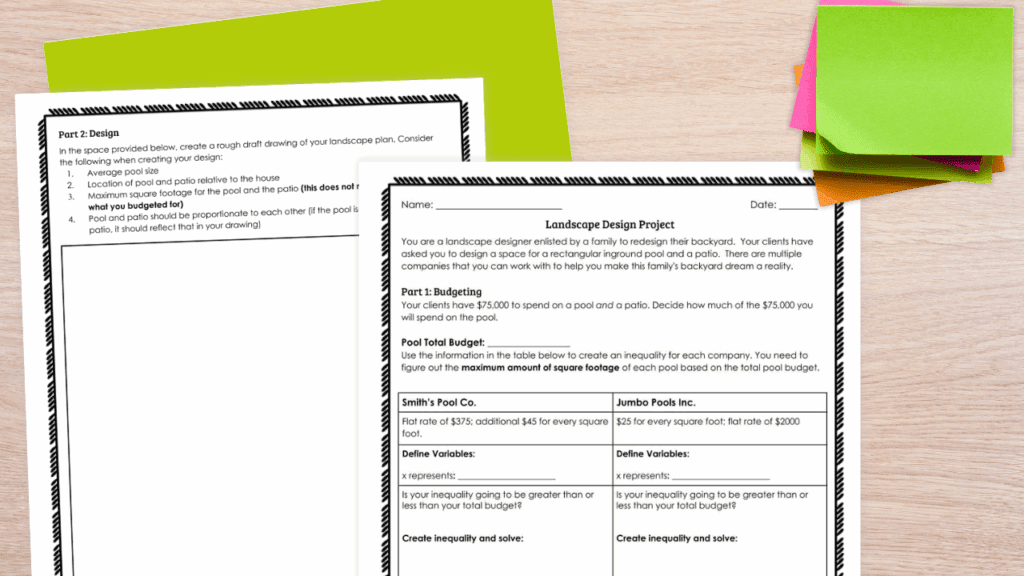
Project-based assessments shine here. For example, in my inequalities project, students design a custom landscape within a client’s budget by writing and solving inequalities. Not only does this activity push them to apply their math skills, but it also encourages creativity, ownership, and problem-solving that feels authentic.
Other ideas for this stage include having students design their own quiz questions, facilitate class discussions, or complete long-term projects that require multiple math skills.
Students who can create with math show they’ve moved beyond memorization and actually internalized the skill by using it flexibly in new, meaningful ways.
Final thoughts about using the Bloom's Taxonomy verbs in your math classroom
Like other theories and taxonomies, Bloom’s can be overdone if teachers and administrators rely to heavily on sticking to these verbs and tiers of higher order thinking.
It’s not just another checklist. They’re a framework to guide meaningful instruction. By intentionally designing activities for each level, you can help students move from simple recall to creating original work with confidence.
And while not every lesson needs to hit every level, sprinkling in opportunities for students to analyze, evaluate, and create will transform your classroom into a space where critical thinking thrives.
Remember: these ideas are meant to encourage quality over quantity. Your assessments can still be extremely telling with fewer questions of higher quality and critical thinking levels.
Looking for ready-to-use activities that bring Bloom’s Taxonomy to life in your math classroom? Check out my Algebra 1 projects and real-world applications that are designed to engage students at every stage.