Every math teacher has seen it: some students breeze through new material, while others get stuck halfway through a problem and shut down. How do we design lessons that challenge all learners without leaving anyone behind? Vygotsky’s theory of the Zone of Proximal Development (ZPD) gives us a roadmap.
The ZPD represents the “sweet spot” for learning. It’s the zone where students can complete a task with some support, but not entirely on their own. In this zone, struggle is productive, and with the right scaffolding, students grow into independent problem solvers.
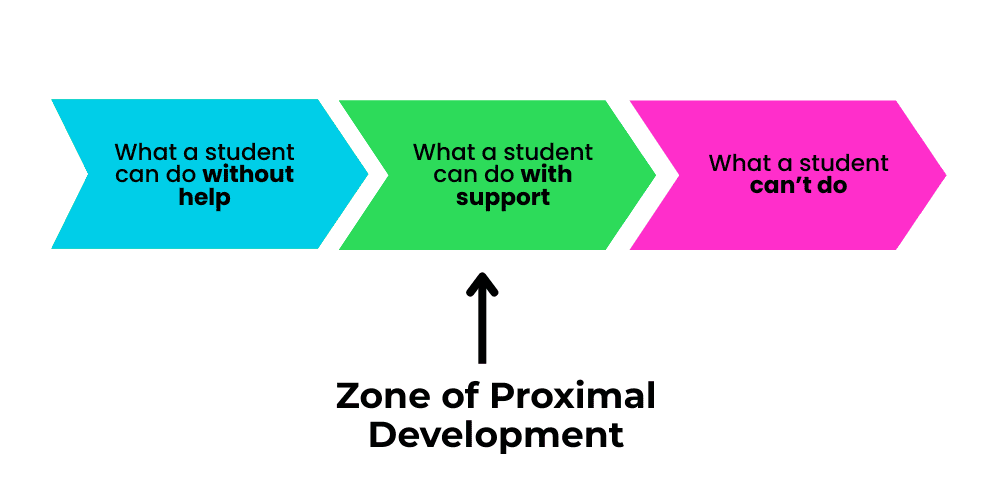
Table of Contents
ToggleWhat ZPD Looks Like in Math
Imagine you’re teaching multi-step equations. Some students can already solve them independently, while others may still be shaky with two-step equations. The ZPD is where you provide just enough support through guided practice, prompting, or peer tutoring to help those students bridge the gap without overwhelming them.
Leveraging the Zone of Proximal Development During Whole Group Instruction
When you are teaching a lesson in a whole group, it can be challenging to reach all of your students. Since they are all at different levels of understanding, there are a few ways that you can assess at that moment what kinds of resources your students will need.
Prompting Questions
Think about the questions that you can ask students during the lesson that will help you see their progress and understanding. So often students don’t know where to start when solving a problem. The first questions I always ask are “what is the question asking us?” and “what information do we already have?”. Modeling these questions repetitively in your whole group lessons will give students a place to start when they are solving problems independently.
Wait Time
The best way to make prompting questions work is by giving your students ample wait time to think about an answer. Yes, it can be awkward to stand up at the front of the class to give your students a minute or two to think through a problem or question, but it is essential to make the most of the zone of proximal development.
When I want my students to take the time to think about a question I just asked, I tell them to take a minute or two and I will let them know when they can raise their hand to answer. Slowing down your lesson makes a huge impact on your students’ understanding and retention.
Guided Practice
Take the time to have your students complete guided practice problems while you still have their attention as a whole group. This will help you assess what each student understands and what you will need to review again.
Encouraging Collaboration During Group Work
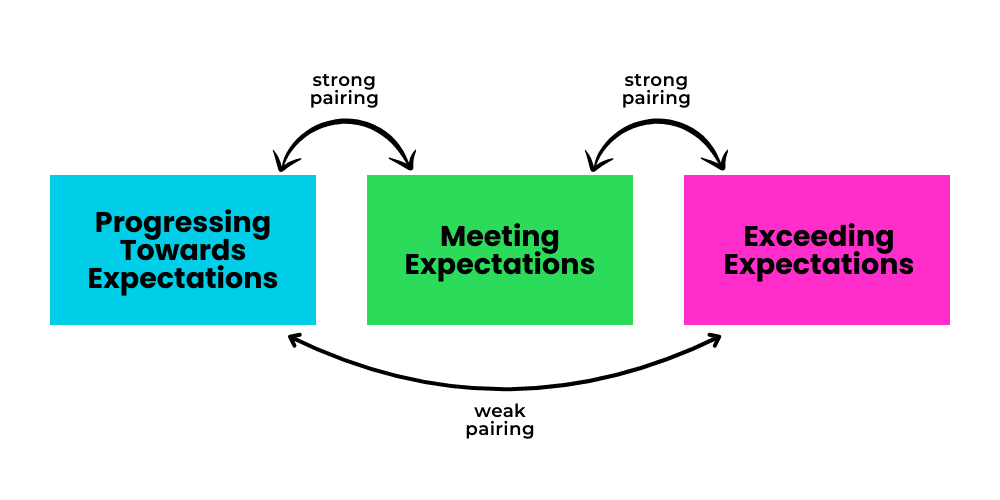
Pair stronger students with those who need more support. In small groups, students often explain concepts in ways that resonate more than teacher-led instruction.
Pro tip: Lower and higher level students pair well with mid-level students, but pairing high level and low level students can sometimes backfire. It’s easy for students who understand a concept in depth to just do the work alone and leave the students who don’t understand behind.
Tools that Support Students During Independent Practice
You can’t (and shouldn’t be) the only tool/resource that your students have access to in your classroom. They need to have their own tools that work for them so that they can work and grow independently.
Guided Notes & Graphic Organizers
Your students’ notes should be organized in a way that they can actually use them as a reference. Before coming straight to your desk, encourage your students to use example problems in their notes or outlined graphic organizers with important formulas.

Reference Charts
Have intentional classroom posters and word walls that students see every day and can use as a reference.

Multiplication Tables & Factor Charts
My students always struggle with knowing factor pairs off the top of their head and often resort to guess and check on their calculator. Although this method works, having tools like these on hand will save them tons of time and frustration.
Why the Zone of Proximal Development is Powerful for Math
Math is often perceived as black-and-white. Students either “get it” or they don’t. But the Zone of Proximal Development framework helps us see learning as a continuum. By planning lessons within students’ ZPD in mind, we normalize struggle and persistence, turning frustration into growth. Students become more resilient learners and are less likely to give up when problems get hard.
The Zone of Proximal Development reminds us that learning happens just beyond a student’s comfort zone. As teachers, our role is to provide the right scaffolding and supports to keep students moving forward. By applying ZPD strategies in your lesson planning, you’ll see stronger engagement, fewer shutdowns, and more confident problem solvers in your math classroom.