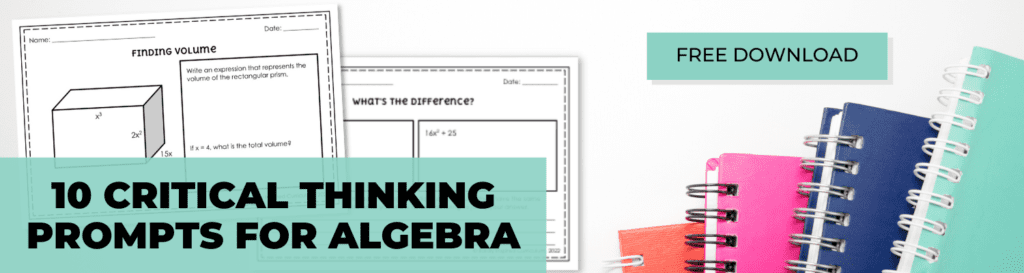
Have you ever noticed that one student soars during a hands-on activity but struggles with word problems, while another student thrives when given a chance to talk through their reasoning with a partner? Howard Gardner’s theory of multiple intelligences helps explain why this happens and gives us a practical framework for designing lessons that meet the needs of all learners.
Instead of assuming all students learn best through traditional logical or linguistic methods, Gardner identified a range of intelligences: logical-mathematical, linguistic, visual-spatial, bodily-kinesthetic, musical, interpersonal, intrapersonal, and naturalistic. For math teachers, this opens the door to more creative and inclusive lesson planning.
Table of Contents
ToggleWhat Multiple Intelligences Looks Like in Math Class
Logical-Mathematical
This is the most traditionally recognized intelligence in the context of mathematics. Students with strong logical-mathematical intelligence excel at abstract reasoning, problem-solving, and critical thinking. They thrive on:
- Problem Solving: Engaging with complex word problems, logical puzzles, and real-world mathematical challenges.
- Proofs: Understanding and constructing mathematical proofs, which require step-by-step deductive reasoning.
- Algorithmic Thinking: Following and developing systematic procedures for calculations and problem resolution.
Visual-Spatial
These learners benefit from visual aids and mental imagery to grasp mathematical concepts. They “see” the math in their minds and on paper. These students need:
- Graphs and Charts: Using bar graphs, line graphs, pie charts, and scatter plots to represent data and relationships.
- Geometric Models: Working with physical or digital manipulatives to explore shapes, volumes, and spatial relationships.
- Diagrams and Illustrations: Drawing diagrams to visualize problem scenarios, understand geometric theorems, or represent abstract concepts.
- Graphic Organizers: Using flowcharts, Venn diagrams, and concept maps to organize information and show connections.

Kinesthetic
Students who learn by doing and through physical interaction thrive with hands-on activities. They need to move, touch, and experience math. Some math classroom tools include:
- Manipulatives: Using concrete objects like blocks, counters, fraction tiles, or geoboards to represent mathematical ideas.
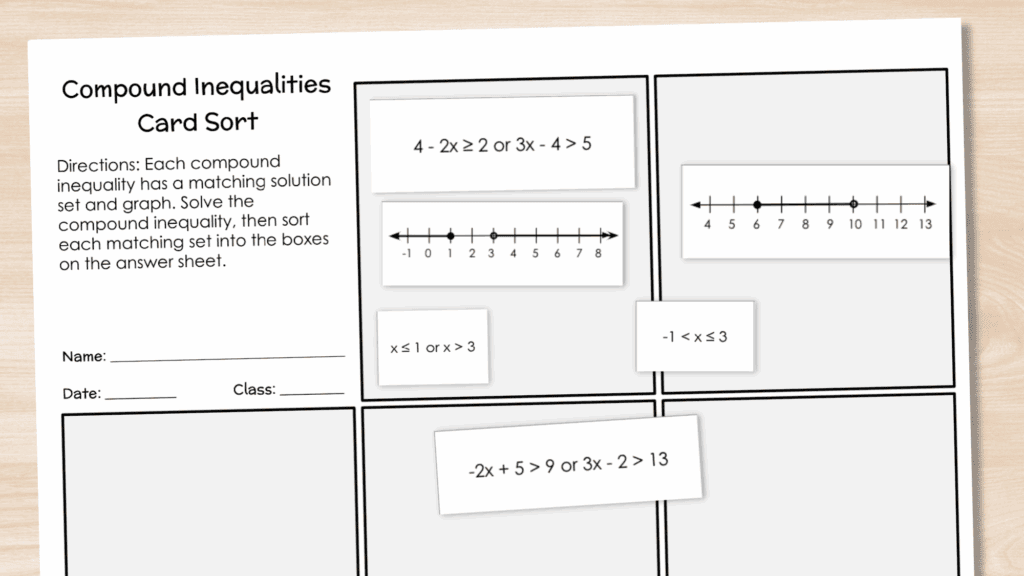
- Card Sorts: Categorizing and organizing mathematical terms, equations, or problems through physical sorting activities.
- Math Scavenger Hunts: Engaging in activities that require movement and problem-solving in a physical space, often involving measurement or data collection.
Musical
This intelligence is often overlooked in math, but incorporating rhythm, patterns, and even songs can significantly aid learning. Musical learners appreciate:
- Rhythm and Patterns: Identifying and creating numerical patterns that have a rhythmic quality, such as skip counting or sequences.
- Math-Themed Songs: Using songs to memorize formulas, times tables, or mathematical concepts.
- Chants and Rhymes: Creating mnemonic devices that use sound to recall information.
Interpersonal
These are social learners who thrive in collaborative environments. They learn best through interaction and discussion with others. Strategies that engage them include:
- Group Work: Collaborating on projects, problem-solving tasks, and investigations.
- Partner Discussions: Explaining concepts to a peer, debating different approaches, and clarifying understanding through dialogue.
- Peer Teaching: Students taking turns to teach concepts to their classmates.
Intrapersonal
These learners are reflective and prefer to work independently, processing information internally. They benefit from opportunities for self-reflection and personal connection to the material. Effective methods include:
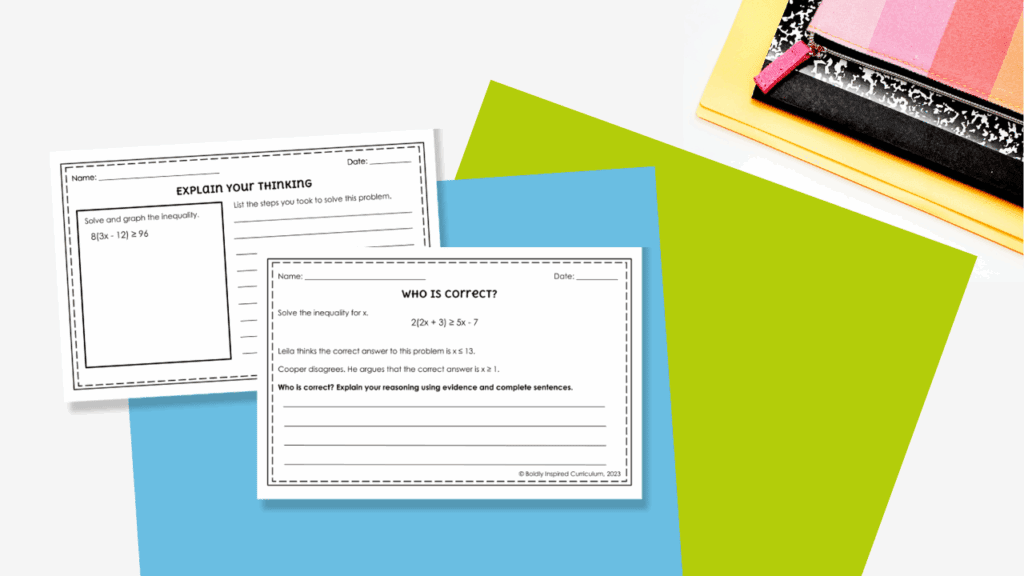
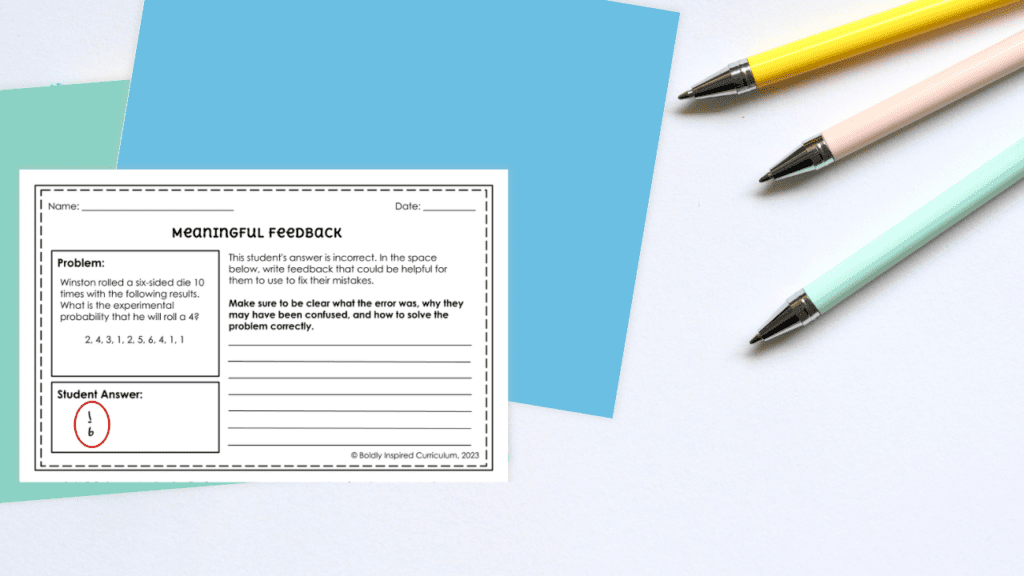
- Reflection Activities: Writing about their understanding, challenges, and insights gained during a math lesson.
- Journaling: Maintaining a math journal to record thoughts, questions, and problem-solving strategies.
- Math Writing Prompts: Responding to prompts that encourage them to explain concepts, justify their reasoning, or connect math to their personal experiences.
Naturalistic
This intelligence connects mathematical concepts to the natural world and environmental data. Naturalistic learners appreciate understanding the practical applications of math in real-world contexts. Approaches for this intelligence include:
- Real-World Applications: Exploring how mathematics is used in biology, ecology, meteorology, and other natural sciences.
- Data from the Environment: Collecting, analyzing, and interpreting data related to weather patterns, plant growth, animal populations, or geological formations.
- Connecting to Nature: Using examples from nature to illustrate geometric shapes, patterns (e.g., Fibonacci sequence in flowers), and mathematical principles.
When math teachers strategically use a variety of teaching methods to accommodate the multiple intelligences, they can make math class more productive for all of their students.
How to Use Multiple Intelligences in Lesson Planning
The beauty of this theory is that you don’t need to plan eight completely separate activities for each lesson. Instead, you can design activities that touch on multiple intelligences. For example:
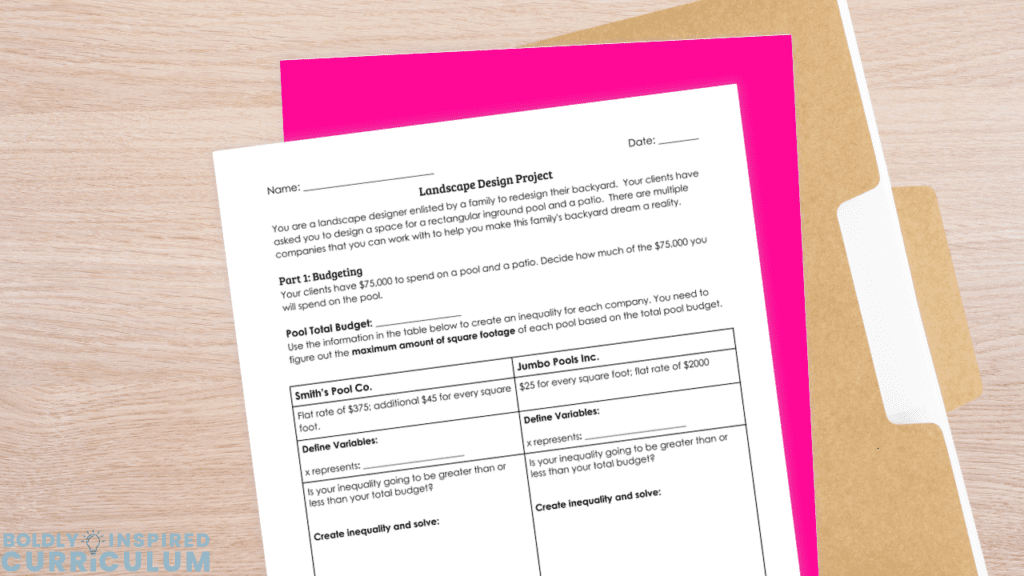
This linear inequalities project involves using templates and creating diagrams (visual-spatial), working with partners to discuss strategies (interpersonal), and reflecting in writing about which design choices they chose and why (intrapersonal).
Why This Works
When lessons tap into different intelligences, more students feel confident and engaged. A student who struggles with symbolic manipulation might surprise you when given the chance to explain their reasoning in words or demonstrate it visually. Multiple Intelligences encourages us to look at math through a wider lens by valuing creativity and diversity in problem-solving.
Final Thoughts About Gardner's Multiple Intelligences Theory
Using multiple intelligences doesn’t mean every lesson has to be a production. Small shifts like incorporating a math writing prompt, offering manipulatives, or planning group discussion questions can make your classroom more inclusive and dynamic. Ultimately, this approach reminds us that math isn’t one-dimensional, and neither are our students.