One of the most powerful ways to help students grow as problem solvers is to teach them how to construct viable arguments and critique the reasoning of others (otherwise known as Mathematical Practice Standard 3).
This standard goes beyond finding the “right answer.” It encourages teachers to challenge their students to explain their reasoning, justify why it works, and evaluate whether someone else’s thinking makes sense. When students can do this, they’re learning so much more than just math. They’re developing critical thinking and communication skills that they will use in college and their future careers.
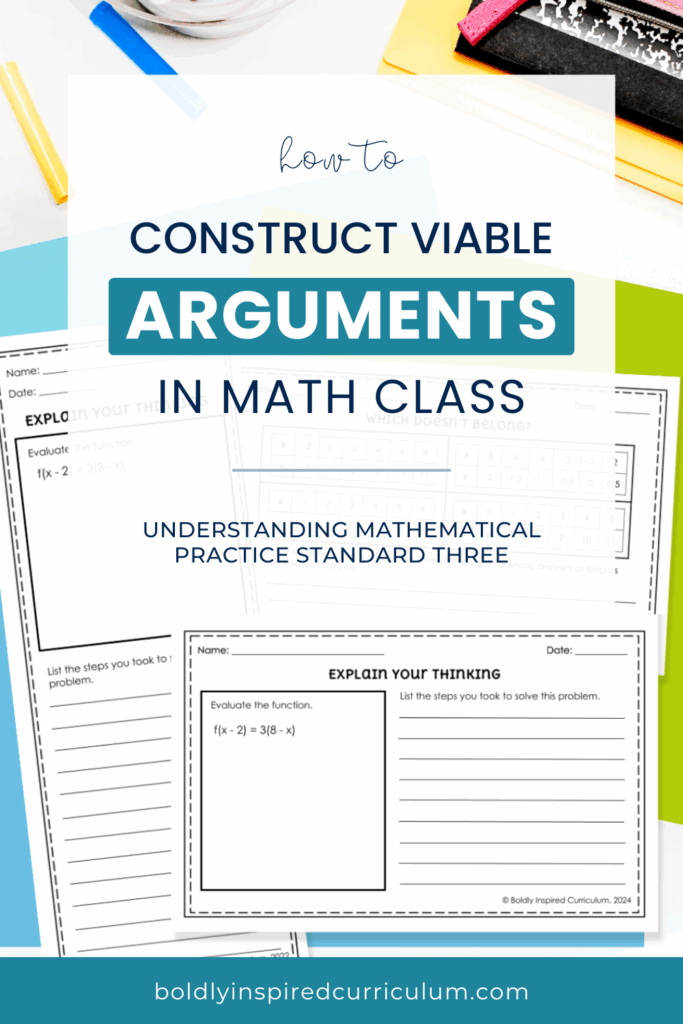
Table of Contents
ToggleWhat Does It Mean to Construct Viable Arguments?
At its core, Standard 3 asks students to make their reasoning visible. Instead of just giving an answer, they should be able to explain why it’s correct. Instead of nodding along when someone else solves a problem, they should be able to determine whether the solution holds up and explain their reasoning either way.
This might look like:
- “I know this is correct because I used distributive property to check my work.”
- “This solution can’t be right, because when I substitute my answer back in, it doesn’t satisfy the equation.”
The focus shifts from memorization to logical argument, which is what makes this mathematical practice so powerful.
Why Do Students Struggle With Explaining Their Thinking?
Most students aren’t used to explaining their thinking out loud or in writing. They’ve been trained to value speed and accuracy, so when asked to defend their reasoning and actually construct viable arguments, they freeze. You’ll often hear vague explanations like “I just knew it” or “It cancels out.”
Critiquing peers’ reasoning can also be challenging. I have found that students look at a sample of incorrect work or a classmate’s answer and assume it is correct. Being able to find the mistake takes true understanding and practice. Keep reading for simple activities that you can add to your routines to help students develop these skills.
Strategies to Bring Mathematical Practice Standard 3 to Life
So often students don’t know where to start when they are asked to construct viable arguments, but there are multiple strategies that you can use to scaffold this skill and build their confidence.
One of the best ways to help students grow in this area is to model what strong mathematical reasoning sounds like. Narrate your thought process as you solve problems: “I know this solution works because when I graph it, the line passes through the points given.” When students hear this often enough, they start to mimic the structure.
Sentence starters also make a big difference. Prompts like “I know this is true because…” or “I disagree because…” give students confidence and language to build arguments. Over time, they’ll stop leaning on these scaffolds and start explaining naturally.
Daily peer discussions are essential, too. Simple structures like Think-Pair-Share or short debates push students to talk through their reasoning in a low-stakes way. For example, you might post a statement on the board, such as “Slope is always positive if a line goes up”, and have students argue for or against it.
Activity Ideas for Teaching Students to Construct Viable Arguments and Critique Errors
When you’re ready to take Mathematical Practice Standard 3 even further, here are three of my favorite ways to make it engaging for students:
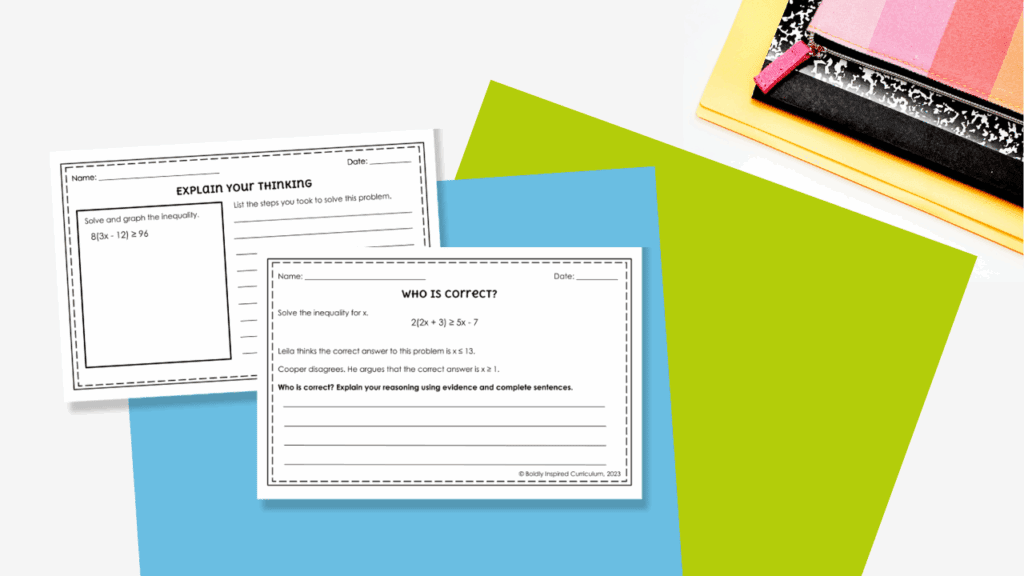
Error analysis is another powerful routine. Instead of only giving problems to solve, provide worked-out solutions with a small mistake. Ask students to find the error, explain why it happened, and write a corrected version. This helps students think critically about the reasoning process, not just the final answer.

Who is Correct? Present two student solutions, one correct and one flawed. Have students decide who is correct and explain why. I love using these questions as warm ups and exit tickets because we can have a whole class discussion about different students’ reasoning and how they got their answer.
Gallery Walks: Post different strategies around the room and let students circulate, leaving comments on the strengths or flaws of each method.

Writing prompts are another tool that often gets overlooked. Quick writes, math journals, or even short exit ticket reflections encourage students to slow down and articulate their thinking in a way they can’t always do out loud.
These activities turn argumentation into a collaborative, interactive part of class.
Why Mathematical Practice Standard 3 Is Worth the Time
At first, incorporating this practice may feel like it slows down your lessons. But the long-term benefits are worth it. Students who can explain their reasoning gain a deeper understanding of concepts, develop academic vocabulary, and become more confident problem solvers.
Answers become less about speed and more about justification, reflection, and connection. That’s the shift this mathematical practice was designed to make.
Final Thoughts About Mathematical Practice Standard 3
Even small changes (like adding sentence starters, modeling arguments out loud, or swapping in an error analysis problem) can transform the way your students engage with math. Over time, you’ll see a classroom culture where reasoning, not just answers, becomes the ultimate goal.
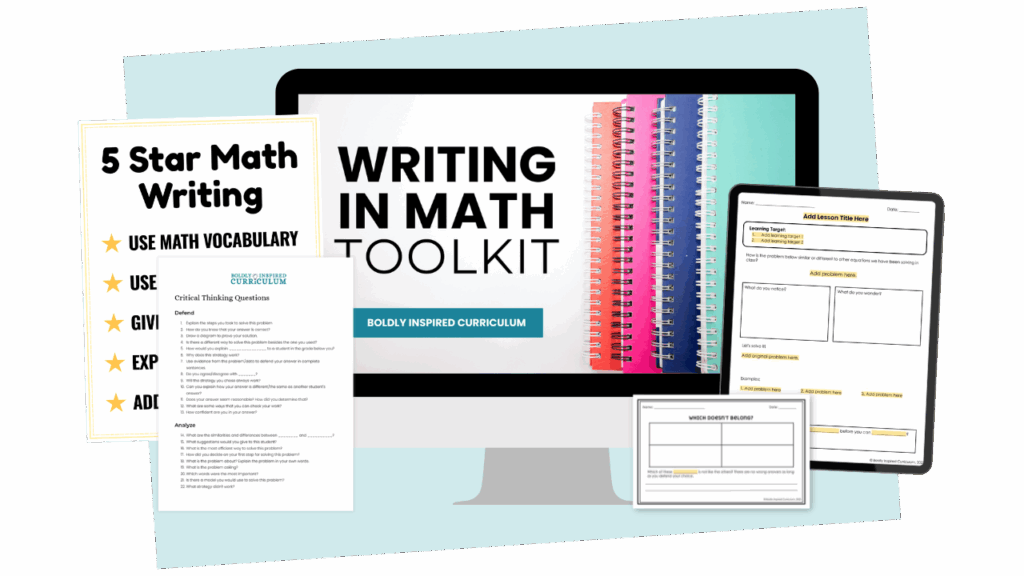
Want support weaving argumentation into your lessons? My Writing in Math Toolkit includes editable writing prompt templates, math journals, and critical thinking questions that make it easy to implement the standards of mathematical practice right away. Click the button below to learn more!